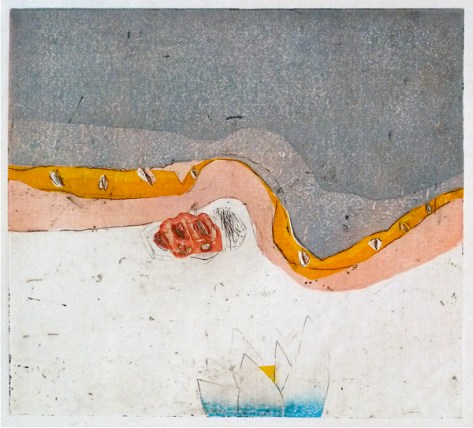
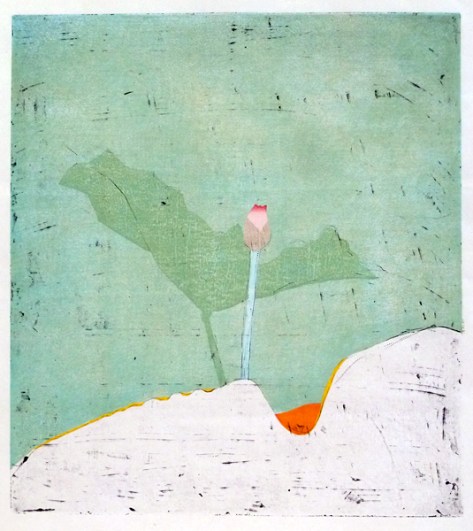
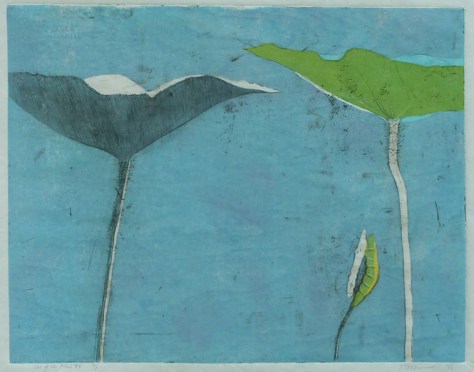
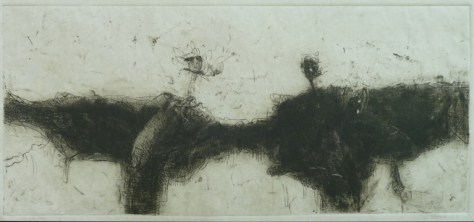
Takeshi Takahara believes in the handmade, the one-of-a-kind, the idiosyncratic. This might seem a counterintuitive attitude in an accomplished master of intaglio printmaking, a medium which embodies the aesthetic of the multiple and reproducible. But in his first solo show at WSG Gallery he demonstrates that his unique, eco-friendly hybrid intaglio/woodcut process for creating small print editions (often only 5 to 9 per title) can deliver artworks that pack all the punch of a one-of-a-kind painting.
Imperfection, a meticulously curated and well arranged grouping of prints on the theme of the lotus, is on view in the gallery from now until October 22. Images that might seem banal in the hands of a lesser artist–who hasn’t seen a thousand pictures of a lily pond?– gain a kind of archetypal resonance through his drawn line which manages to be both awkward and graceful, with an effortful visual stutter that is reminiscent of the knowing clumsiness of Henri Matisse or Paul Klee. Through constant experimentation in the studio he has adapted the process of intaglio printmaking, replacing the metal plate and acid with a less toxic combination of materials while still retaining the sharpness of the cut line. His beautiful-but-not-pretty colors are carefully mixed from watercolor and dry pigments purchased in Japan.
Transpiration II
Takahara relishes the way in which each print is a document which can be seen through multiple stages on its way to the final version. “In printmaking, you can actually print images step by step and have it. By looking at that proof, you make additions or deletions and move onto another print again and compare those two and see the differences…You get to rethink, revise and remake your original ideas.” He describes himself as uninterested in producing large editions of his prints, preferring instead to experiment with the infinite possibilities of changing and adapting each plate and combining them in endlessly varied ways. “Repetition is not my forte,” he says, laughing.
Out of the Mud XV
Born in midcentury China to Japanese parents, Takeshi Takahara came to the U.S. to escape his future as the eldest son of a traditional Asian family. He was expected to get a good education and to enter a respectable profession, which fine art certainly wasn’t. “If I’d stayed in Japan, I’d be working in a bank,” he says.
His first stop in the U. S. was Smith College, where he studied with renowned sculptor and printmaker Leonard Baskin. Studies at the newly formed school of printmaking at the University of Iowa followed, where he was mentored by Mauricio Lasansky, considered by many to be one of the fathers of modern printmaking. Although he is now a veteran artist and teacher, this is Takahara’s first experience with an artist-run gallery.
Out of the Mud
Takeshi Takahara is currently hard at work creating new prints on the theme of the lotus, which has deep symbolic meaning for him. The lotus rises from the muck and produces a beautiful pure flower, a metaphor for the human condition. “We all come from the same muck, and what we become as human beings is the flower,” he says.
For more information about WSG Gallery’s hours and programs go here
The sprawling multimedia, multi-artist show Re: Formation which recently closed in Toledo has moved to a smaller venue in Gallery 117 at the Ann Arbor Art Center where an edited version will be on view from now until October 8. Toledo’s Re: Formation was overwhelming in size and scope. Installation and video dominated the cavernous former department store, contributing to an immersive experience that viscerally conveyed artists’ current outrage over racism, war, environmental degradation and urban decay.
The rage, the politics, the anger at injustice and environmental ruin remain in this new iteration but in a lower, more thoughtful key. Smaller work which was somewhat eclipsed by larger and noisier art in Toledo now gets some well deserved attention.
Behind the Clouds by Sharon Que
Moving an exhibit from one very large venue to another smaller one presents unique challenges for Gallery Project’s curators Rocco DePietro and Gloria Pritschett.
Pritschett explains, “In downsizing the exhibit for Ann Arbor, I look for the core of the work, so that the artist’s essential intent stays intact and can at least be glimpsed… we want to downsize the installation without giving the sense that we just lopped off a part of it.”
“ It’s a challenge, but a fun challenge,” adds DePietro.
Pritschett continues, “In reassembling the exhibition in a much smaller space, the work is tightly placed, so the specifics of relationships among the works is more crucial. No one piece has a place apart to sprawl on its own as it could in Toledo. I really enjoy the challenge in the patient work of positioning and repositioning individual works and groups of works, until they cohere visually and conceptually and relate to each other comfortably and meaningfully. For example, the group of Mark Hereld, Endi Poskovic, Tohru Kanayama and Barry Whittaker, and the interactive works Yusuf Lateef, John Anderson and Anthony Fontana, each in some way expresses formation and reformation as a process. Placing them was really satisfying”
“After spending a month with the exhibit in Toledo, we discovered new relationships among various pieces — themes, shapes, colors, concepts — that we exploited in installing the exhibit. For example, the interplay of blacks and reds, strong concept works, and the iconic water towers in Flint,” says DePietro.
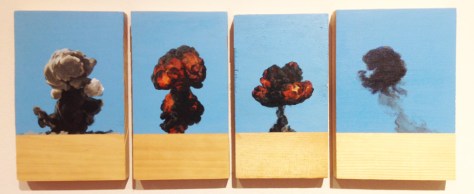
Boom Series by Boris Rasin
Pieces with an environmental theme, such as Jessica Tenbusch’s Veil and Mark Hereld’s white-on-white Becoming@42Mx are often necessarily scaled to the size of the natural objects they contain, and this new, smaller space allows them to shine. Tenbusch’s work, which frequently includes taxidermy such as preserved frogs, snakes and the like, can be seen and appreciated for its meticulously detailed and finely produced craftsmanship.
Becoming @ 42Mx by Mark Hereld
Paintings which were a bit overwhelmed in the large, dim Toledo space come into their own here. John and Sandy: Voices for Social Justice, a large painted allegory (notice the small winged figure of Governor Rick Snyder in the upper left hand corner) by Ken Milito is impressive, and Michael Nagara’s Garden of Watery Lead seems at home in this smaller scale and more brightly lit gallery.
Equally successful in both Toledo and Ann Arbor is John James Anderson’s photo series 189 Hydrants, which documents, hydrant by hydrant, Washington D.C.’s decaying infrastructure. His Omikuji also stands up well to the move. Based on a Japanese cultural custom meant to end a curse, gallery visitors are encouraged to participate in a ceremonial exorcism to end police killings.
“In the wake of the recent deaths of Philando Castile and Alton Sterling, I took a moment to consider the thousands of other lives lost in recent years during an encounter with the police,” says Anderson.
He adds, “While the circumstances behind each are different, in sum, it is as though there was a great curse within our culture that causes these issues to persist.“
In this improvised and sobering ritual, the name of a young man of color who has died at the hands of the police is printed on a strip of paper along with the Kanji for “end curse” and tied to the wooden structure in the gallery.
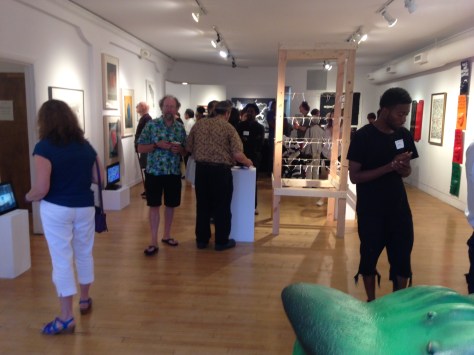
Opening reception at Gallery 117, Ann Arbor ArtCenter, with Omikuji by John Jacob Anderson’s Omikuji at center right.
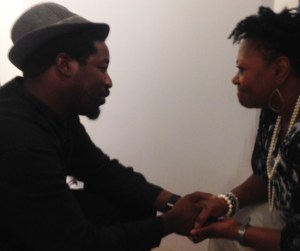
Yusuf Lateef in an encounter with Saganaw photographer Mary E. Foster
The single most memorable work in Re:Formation remains The Reconditioning, an experiential performance and personal encounter designed and executed by Toledo artist Yusuf Lateef in collaboration with Chris Rogers, Kevin Gilmore, Daren Mac and James Dickerson. Lateef was initially apprehensive about reproducing The Reconditioning for an Ann Arbor audience after a previous cathartic experience with audiences at Re:Formation in Toledo. He was afraid he would be “reproducing this thing that wasn’t a personal and individual experience.” The placement of the installation at the entrance of the exhibit made him feel as if he and his fellow performers were in danger of becoming objects in an art show. But The Reconditioning, once again, found an audience of eager participants willing to engage the artists/performers on the subject of race and connection. Lateef, encouraged by recent experience, plans to refine and simplify these encounters in the future.
“It took time to get out of my own way,” he says.
For more information about Ann Arbor Art Center go here
Artists exhibiting in Re:Formation are: Heather Accurso, Hiba Ali, John James Anderson, Michael Arrigo, Siobhan Arnold, Nick Azzaro, Darryl Baird, Barchael (Barry Whittaker and Mike Bernhardt), Morgan Barrie, Carolyn Barritt, Beehive Design Collective (Meg Lemieur), Mark Bleshenski, Jada Bowden, Seder Burns, Ruth Crowe, Dana DePew, Rocco DePietro, Desiree Duell, Dianne Farris, Susan Fecteau, Anthony Fontana, Mark Hereld, Dan Hernandez, Stephanie Howells, Tim Ide, Doug Kampfer, Tohru Kanayama, Yusuf Lateef, K.A. Letts, Kate Levy, Julianne Lindsey, Jeremy Link, Melanie Manos, Shanna Merola, Ken Milito, Michael Nagara, Jefferson Nelson, Endi Poskovic, Gloria Pritschet, Sharon Que, Raizup Collective (Antonio Cosme), Boris Rasin, Roger Rayle, Jesse Richard, Arturo Rodriguez, Gary Setzer, Meagan Shein, Anna Schaap, Sheida Soleimani, Brian Spolans, Jessica Tenbusch, Alex Tsocanos, Ellen Wilt, Robin Wilt, and Viktor Witkowski.
Cathy Jacobs doesn’t remember not being an artist. As a child she sat at the vanity of her upstairs bedroom drawing obsessively for hours.
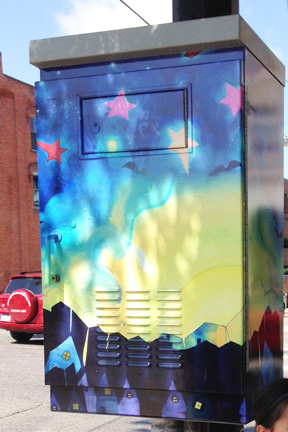
Starry Sky by Cathy Jacobs
“I was always drawing from the time I was 3 or 4. When I was 7 or so, I thought I can be an artist! I had a vision of a sort of Salvador Dali character in a beret and a pencil mustache.”
In fact, she remembers dressing up as the surrealist master for Halloween one year. This seemed perfectly natural to her, since art was a man’s world at the time.
“I always thought I’d grow up to be a man” she says, laughing.
The image Starry Sky that was chosen for the PowerArt Project box now installed at Miller and Main in Ann Arbor, comes directly from her childhood memories. She vividly recalls looking out of her bedroom window at the night sky and the houses in her Ferndale neighborhood. “I didn’t like that they were so uniform, so I invented columns and balconies for them in my mind,” she says.
Interface by Cathy Jacobs, 2012
Jacobs’ interest in painting and drawing was a constant throughout her childhood and adolescence and was followed by college art studies. She studied painting at Wayne State University where she earned a B.F.A. and continued at Eastern Michigan University where she graduated with a Master of Fine Arts in Painting degree in 2015.
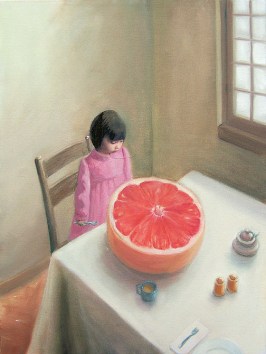
Breakfast of Champions by Cathy Jacobs, 2010
Jacobs’s paintings from this period are figurative and show a strong interest in fantasy and storytelling. Fairytale archetypes and mysterious situations, puppets, dolls and queens populate her pictures. They have the quality of half-remembered dreams, fascinating and just out of reach.
Her work at this time was well composed and expertly painted, but Jacobs felt dissatisfied. She wanted the color, translucency and light in her paintings to escape from the picture plane and from narrative imagery. She experimented with various sheer or translucent materials–metal screen, gauzy silk and the like–collaged onto her paintings. The kind of lightness and atmosphere that she wanted seemed impossible to achieve with the media at hand.
But then, in 2014, Cathy Jacobs discovered weaving. Finally, this new medium allowed her to escape the painted canvas and the drawn image.
“It immediately took hold of my imagination. Through weaving, I found that I could express the full spectrum of colors and moods, but in real 3-dimensional space…I learned weaving and all of a sudden all the things I was thinking about in my paintings, the depth you would get through layers of color and translucency, I found I could get in 3 dimensions.”
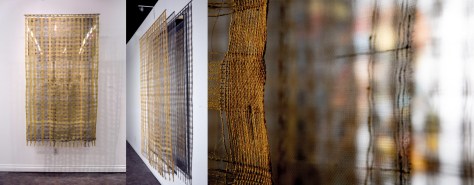
Portal by Cathy Jacobs, 3 views, handwoven linen, aluminum screen, mirror, metal hangers
Cathy Jacobs sees the way before her clearly now. “My current focus is in weaving panels of linen that, when layered together create vibrating fields of color.” She has already had some success, exhibiting her woven panels at Sofa Chicago 2015 on Navy Pier, and in the 2016 Architectural Digest Design Show in New York City. This fall, her work will be featured in World of Threads in Ontario, Canada.
Jacobs enjoys both the process of weaving and “the sense of finality and completion that comes when I finish a piece.“ She seems to have found the means and medium to bring to the real world the contents of her imagination. Every working artist knows that this clarity is a temporary thing in a long creative life. Cathy Jacobs is a young artist and the future may see changes in her art practice, but for now she is happy in her woven world.
“It feels like a really good fit, ” she says, smiling.
Dress for Success by Michael Dykehouse at Gallery 117, Ann Arbor
It’s August and it’s hot. I’m tired of thinking about politics…and art and politics. But it looks like it’s going to be at least 76 more days until the end of our collective season of discontent, so I’m treating you and me to a staycation of some fun art that’s available for your viewing pleasure in the Detroit metro area right now.
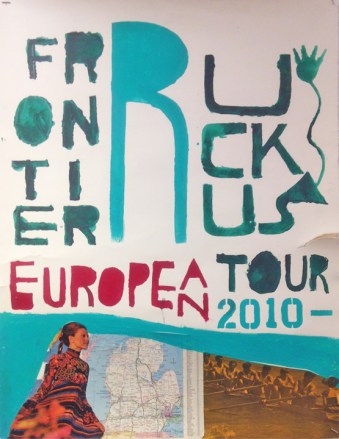
European 2010 Tour Poster by Matt Milia
First up, there’s the fizzy pop-up show Ultimate Stars in Gallery 117 at the Ann Arbor Art Center from now until September 3. Musician and photographer Doug Coombs and his talented friends have put together this eclectic free-for-all: drawings, paintings, puppets, posters, music. It’s all playful, colorful and occasionally silly (but in a good way). Check out a wall full of tacked- up, un-framed doodly watercolors by Jim Cherewick or take a look at the funny/creepy black and white ink drawings of Chris Pottinger. And, if you want to hear catchy tunes by the musicians who performed at the opening go here.
Artists in Ultimate Stars are: Scott Allen
Misty Lyn Bergeron, Sarah Campbell, Jim Cherewick, Michael Dykehouse, Patrick Elkins, Greg McIntosh, Tadd Mullinix, Chris Pottinger, Fred Thomas.
Wasserman Projects, near Eastern Market in Detroit, is hosting its Summer Selections right now in a portion of the gallery, while also working on their upcoming installation Cosmopolitan Chicken by Dutch artist Koen VanMechelen. (Cosmopolitan Chicken, opening this fall, features–yes, you guessed it–chickens.) The Summer Selections paintings are smart and humorous and well worth a look while we wait for the poultry to make its appearance. Artists in Summer Selections are: Ken Aptekar, Peter Zimmerman, Jason Yates, Michael Scoggins, Emilio Perez, Kent Henricksen, Ed Fraga, Jose Vincench, Nancy Mitchnick, G. Bradley Rhodes-Aubrey, Josh Bolin, Koen Vanmechelen, Willy Verginer.
Anemic Royalty by Josh Bolin
Smile Everyone by Jason Yates
God Complex by Michael Scoggins
Tyree Guyton Installation at Inner State Gallery
Just down the street from Wasserman Projects is Tyree Guyton’s current solo show, Face-ology, on view throughout the month of August at Inner State Gallery. These appealing, simply composed pictures with their bright, flat house paint colors on recycled grounds have the rough urban feel of the Heidelberg Project but in a gallery-friendly format.
“Face-ology is a reflection of everything that is changing about Detroit; the face of the landscape, the face of the people and even my own face,” says Guyton.
And last but not least, you still have time (just barely) to see Intersection: Jef Bourgeau/ Matt Eaton at Galerie Camille. Until August 27, these bright and sophisticated paintings and digital prints from two of Detroit’s best known independent curator artists are available to soothe your sore eyes.
Ann Arbor artist Valerie Mann has invited you to a cocktail party.
Attractive young women in tasteful jewel-toned taffeta gowns carry demure evening clutches and make polite chitchat. “This is fun!” you think. But then you take a closer look.
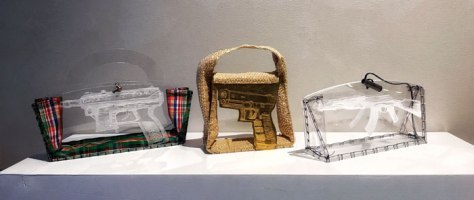
Three Clutches by Valerie Mann
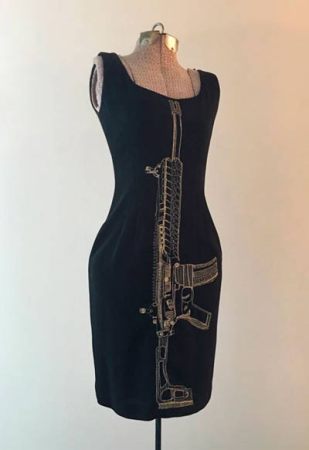
There is gun violence-a lot of it- at this party too. Each chic vintage cocktail dress in this installation at WSG Gallery has been carefully embroidered with images of the specific guns employed in recent U.S. mass shootings. The accompanying Lucite handbags–upon which drawings of guns are etched–give new meaning to the term “open carry”.
In Gun Show, Mann has served up a disturbing series of meticulously created objects that invite us to re-think why it is that guns and gun violence have become part of the background noise of American civic life. The artist herself seems puzzled by her juxtaposition of the conventionally pretty and the unspeakable:
“It seemed much easier before I started the making process. I don’t mean the actual, physical making of the work was so taxing to figure out, I mean it has been psychologically difficult.”
Using her sewing machine as a drawing tool, Mann has embroidered Sig Sauer MCX 223 rifles, Bushmaster semi-automatics and Glock 21.45 semi-automatic rifles on party dresses to commemorate the Orlando Pulse nightclub shooting (Dance all Night), The Newtown Connecticut massacre (Big Guns Little People), the Charleston S.C. church shootings (Sunday Best). The specificity of each image adds bite to the social commentary.
Dance All Night (Orlando Pulse Nightclub)
The embroidered and etched firearms are carefully, one might almost say lovingly, crafted. Luxury materials — Lucite, silk, gold leaf — invite touch even as the image repels. Mann admits to the intrinsic and self-contradictory attraction of the gun:
“I shocked myself when, after many drawings of guns, I admitted how sexy they were.”
She acknowledges that gun violence became more and more difficult to address clearly as she researched the interlocking motives and conditions that result in specific atrocities: mental illness, racism, terrorism and lax gun ownership laws, to name a few.
The idea for Gun Show came to Mann some time ago, when she first heard about the Columbine shootings. This was the first time, she said, “where children were the shooters AND the victims, and when I first felt that the adults of society had really let down the next generation. We’ve let them down because of our unwillingness to talk about difficult things in a rational way, or to compromise.”
Art works, even very provocative ones, don’t have the power to change public policy directly. But they are not nothing either. Changing minds takes time and sustained attention and ultimately, political action. Valerie Mann has taken a courageous first step by bringing up the subject of gun violence in the polite environs of an art gallery. It is the responsibility of her audience to care enough to do something about it in the political arena.
Have you seen Gun Show? Would you wear a dress with guns on it? I’d be interested to hear your thoughts.
Gun Show is on view at WSG Gallery from now until September 10. For more information about WSG Gallery go here
Lately I’ve been spending a whole lot of time on the hot, hot streets of Ann Arbor, looking at some cool traffic box wraps that have just been installed all over town. After the chaos and cacophony of the Ann Arbor Art Fairs last week (which features the work of excellent and not-so-excellent artists from around the country) it’s a pleasure to see work by accomplished local talent while walking leisurely down the now-deserted streets.
The PowerArt! project is sponsored and managed by Arts Alliance in co-operation with the Downtown Development Authority and Ann Arbor Public Arts Commission. Not only do these easily cleanable vinyl-wrapped traffic boxes add interest to the urban streetscape, they also -sneakily- discourage graffiti and tagging. I’ve seen projects like this in my travels, most recently in Seattle and Minneapolis, and now power box wraps have come to our fair city. The project features images from Washtenaw County artists, some of whom I know (I’m one of them) and some I’d never heard of.
Pen Pal by David Zinn
by David Zinn
Legato by Sophia Zhou
Tibet by Yiyi Zhang
People in the City byXiang Li
Woodland by Nawal Motawi
Thickets Within by Mia Risberg
Pollinators by Thomas Rosenbaum
Row of Pines by Leslie Sobel
Orchard 6 by Jill Stefani Wagner
Animal Life by Bruce Worden
Dancing Muses by K.A. Letts
Starry Sky by Cathy Jacobs
Impressionist Main St by Walter Griggs
Pedestrian by Tim Gralewsky
I was curious so I googled them. Where have I been? What I discovered was that Ann Arbor/Washtenaw County is home to an amazing group of accomplished arts professionals that are keeping a very low profile. There’s a science illustrator, an accomplished museum conservator, a comic and children’s book author and a caricaturist (just to name a few). There are also numerous artists who teach at all levels as well as working hard on creating their own art.
I think it’s some kind of a crime that many of these creatives haven’t (up to now) been widely known and appreciated in their home town. So in the coming months I will be periodically interviewing them for RustbeltArts.com. Stay tuned!
I will be going on vacation in the next two weeks, and since this is a one-horse operation there will be a short hiatus in my posts. If you want to read about Michigan arts and artists while I’m gone, there’s a good story by former MLive arts reporter Jenn McKee about PowerArt! project from Culture Source . There’s also an interesting interview with Bruce Worden (the afore-mentioned science illustrator) here
Midsummer, a collaboration by Barbara Brown and Howard White
Despite its prosaic title, Book+Paper Arts packs plenty of charm and interest into a tiny gem of an art exhibit on view from now to July 30 at WSG Gallery in Ann Arbor. The art books and some additional paper-based art works represented are approachable, interactive, playful. Travel and globalization, the book as historical artifact and its position in relation to new media, and the components and ordering of meaning within an artwork are just a few of the themes addressed. The participating artists are clearly in an ongoing creative dialog through “book shaped objects” in various configurations, each type with its conceptual strengths and limitations.
This is the seventh in a biennial gallery exhibit series, Beyond Words, curated by Barbara Brown, noted book artist and lecturer in book arts at the University of Michigan Penny W. Stamps School of Art and Design. She describes her curatorial aims for this particularly varied selection of paper based artworks:
In previous show statements, I have put forth the assertion that the term ‘artist’s book’ often triggers much discussion, even bickering and irresolution amongst book artists, and the point has sometimes been made that at the very instant one uses that term, one must then be ready to define it and to defend the definition! There will probably never be a determination that everyone agrees on, but I like ‘book inspired art’ (or even BSO – book shaped object), and for me, that is a good beginning”.
Memorial to Thylacines by Ted Ramsey
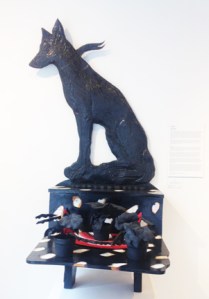
Travel, through time, through space, is a recurring theme throughout this exhibit. The molded paper mini-installation entitled Memorial to Thylacines and Our Slaughtered Michigan Wolves by Ted Ramsey describes his trip to Tasmania during which he encounters memories of the extinct Tasmanian Tiger, a species of carnivorous marsupial.
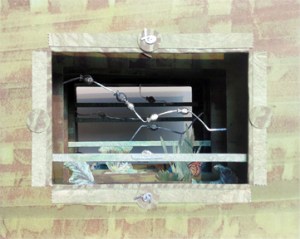
Norma Penchansky-Glasser, inspired by a trip to Idaho, has created a varied and beautifully hand-crafted suite of books. A particular favorite of mine was Boise Aquarium, a tunnel book that features tiny silver fish swimming within a paper proscenium. (The tunnel book was new to me, and several artists created these for the exhibit. This form had its origin in the 18th century as an easily portable souvenir for tourists.)
Jack O. Summer’s Mapaloopsa, in which he meticulously re-configures various maps into an invented world atlas, humorously illustrates globalization and mass migration. In one map, Dearborn meets Quebec, which has sidled up against Burma. We are sharing a smaller and smaller planet with new neighbors who make strange bedfellows.
The block book form receives special attention from several artists in this exhibition. These collections of wooden blocks lend themselves to the exploration of multi-sided meaning and the ordering and reordering activity it allows. In Blocks of Time by Ruth Bardenstein, each constituent block side contains ancient alphabets or astronomical images or clock components. Alvey Jones’s Encrypted Alphabet addresses the written word and constructed meaning. One side of each block has a picture inscribed with a written word that bears no obvious relation to the accompanying picture, leaving the viewer to puzzle out the implied relationship.
Books with digital components make an appearance here too, with Barbara Brown and Howard White’s Midsummer, a tunnel book with video. The most conceptually complex artwork in the exhibit, to my mind, is Algorhithms by Ian McLellen Davis and Meghan Leigh Forbes. This is a collection of pamphlet musical exercise books which can be played in any order with an accompanying “music box” of recorded fragments which can be activated by the listener (who then becomes the “player”). Added to all this are some beautifully produced pamphlet books containing bits of Roland Barthes’ intriguing thoughts on music available for the taking (I took one).
I spent quite a bit of time in Book+Paper Arts without ever feeling I had completely grasped all the formal and thematic intricacies of the exhibited works. I only wish that more space within the gallery had been devoted to the exhibit. I realize that in a commercial gallery space is money, but these pieces deserved more room than they got. A few more inches around each piece (or even an additional wall) would have contributed a lot to my enjoyment of this museum-quality small show.
Artists in this show include: Ruth Bardenstein, Barbara Brown, Meghan Forbes, Alvey Jones, Ian McLellan Davis, Norma Penchansky-Glasser, Susan Skarsgard, Jack O. Summers, Ted Ramsay, Howard White.
Pictured clockwise from top: Encrypted Alphabet by Alvey Jones, Alphabet Pop-Up by Susan Skarsgard, Blocks of Time by Ruth Bardenstein, Idaho by Norma Penchansky Glasser, Mapaloopsa by Jack O. Summers
Comics Unbound, an exhibit that examines the art and the craft of the comic, is on view right now through June 24 at Ann Arbor Art Center’s Gallery 117. The show aims to illustrate the process through which comics, both in short and longer form, are created. It “reveals what is usually an invisible narrative in comics–the journey from artist’s vision to clear transmission of meaning. ” according to jurors and comic artists Jerzy and Anne Drozd. The exhibition contains original drawings by cartoonists who will appear at the Ann Arbor Comic Arts Festival to be held at the Ann Arbor District Library, June 18 and 19, 2016.
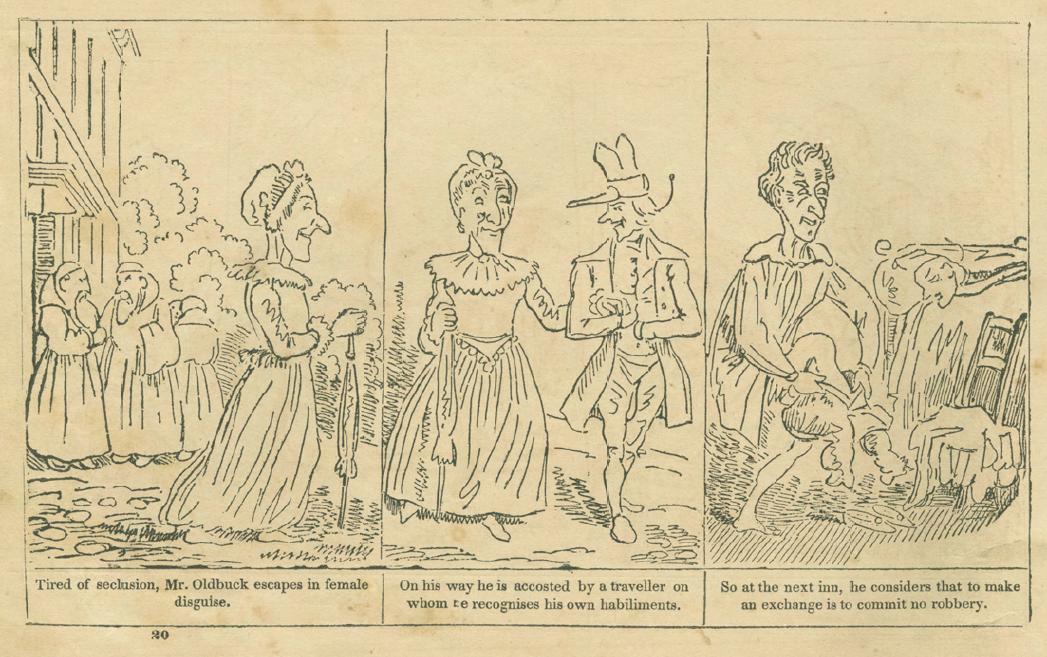
The Adventures of Obadiah Oldbuck
Ever since humans began making marks on flat surfaces, visual storytelling and the interplay between picture and text has been an important part of western art history. From neolithic cave painting to Egyptian hieroglyphs to medieval panel painting, the extent to which pictures and text cooperate to tell a story has depended on the literacy (sometimes more, sometimes less) of the general population. The invention of movable type in the mid-15th century in Europe revolutionized literacy and consequently, visual storytelling. Once most everyone could read, the path was paved for the first comic book, generally thought to be The Adventures ofObadiah Oldbuck in 1837. From there the scope and reach of comics has only increased, until now there is a whole section in the New York Times Review of Books devoted to graphic media. Numerous superhero movies based on comics appear every summer and Fun Home, a musical adapted from a graphic novel is currently running on Broadway.
Dragon Beware by Rafael Rosado
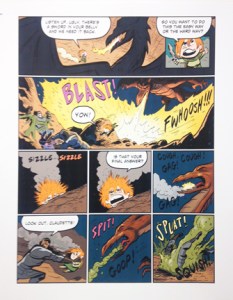
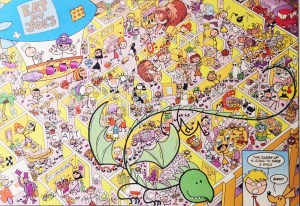
Rather than dwelling on the history of comics though, this exhibit is organized to convey an idea of how comics are produced: from script and hand sketched storyboards, to drawing and coloring of the finished comic, with printed versions also on display. The show also gives a fair idea of the range of subject, mode of visual expression, variety of intended audience and level of literary ambition currently available to this medium. The pictorial styles on display range from the intentionally rudimentary but elaborately composed stick figures of Matt Feazell’s Too Much Help to the the 1950’s-retro washy ink drawings of Apooko by Mike Roll to the classic super-hero comic style of Tom Mandrake in Creeps. The subjects likewise range from personal and autobiographical (El Deafo by Cece Bell) to comic myth (Dragons Beware by Rafael Rosado) to historical (Feynman (Tuva) by Jim Ottovani and Leland Myrick ). And the literary language from one comic to another is just as varied as the pictorial expression.
Too Much Help by Matt Feazell
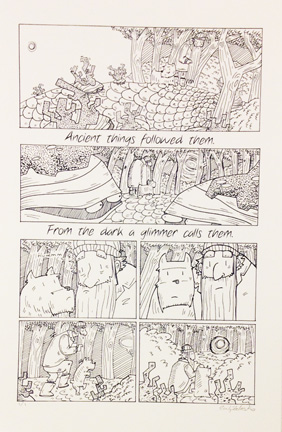
All of the artists in Comics Unbound display impressive levels of drawing ability personal to their individual style and loads of storytelling originality. A particular favorite of mine was Old Man, Dog and the Ocean by Emily Zelaszko. Her drawings are deft and idiosyncratic and her compressed language rises to the level of poetry. I also especially liked Mike Roll’s Apooko drawings and Carolyn Nowak’s Nichols Arboretum but this probably reflects my own personal taste for certain drawing styles rather than any defensible aesthetic preference.
The conclusion I draw from Comics Unbound is that comics, while they contain visual media, are not primarily a visual art. Rather they are more literary in nature, with visual augmentation, and their narrative strengths lie mostly in the area of dialog. This might explain the frequency with which comics are developed into movies. The storyboards in this exhibit certainly have a cinematic quality. It seems to me that as an art form graphic novels and comics have most in common with theater and film. They are meant to be consumed as literature or performance, rather than to be contemplated as fine art paintings and drawings.
Old Man, Dog and the Ocean by Emily Zelasko
The great advantage of comics over film however, is in the personal nature of their content and the relative ease with which the artist can translate private stories and concerns into a public medium without the necessity for elaborate technical support. The comic artist can, literally, express on the page anything she/he has the imagination to invent and there are far fewer practical barriers to self expression than in more public media like theater or film. The artists in Comics Unbound make full use of the broad scope of visual and literary expression that the medium offers them.
Artists in the exhibit include: Mike Roll, Emily Zelasko, Rob Stenzinger, Carolyn Nowak, Zack Giallongo, Cece Bell, Rafael Rosado, Ben Hatke, Ruth McNally Barshaw, Samantha Kyle, Cyndi Foster & Jeramy Hobbes, Jim Ottaviani, Matt Feazell, Dan Mishkin & Tom Mandrake.
It’s a well-known fact that few visual artists working here in the Rust Belt have a realistic hope of making a living exclusively from selling their art. So many find themselves teaching to make a living while also trying to keep up their studio practice and actively showing their work. This requires energy, dedication, resourcefulness and maybe an ability to do without a full night’s sleep. The show currently in Gallery 117 displays the diverse skills of the hardworking artists who give instruction at the Ann Arbor Art Center, from printmaking to painting to ceramics to animation and more. In a show of this kind the technical mastery of each artist is on display, and the artworks have to be enjoyed for their individual charms rather than appreciated in relation to an overarching theme. The level of skill on display is impressive, as one would expect from an instructional staff that is tasked with teaching the technical aspects in their area of expertise.
War Baby by Heather Accurso
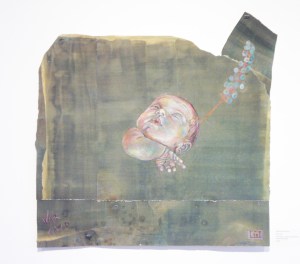
I came to the exhibit already knowing the work of some of the artists represented, among them Heather Accurso. I’ve liked Accurso’s drawings ever since I discovered them at Packer Schopf Gallery in Chicago. Yet another MFA graduate of the School of the Art Institute of Chicago, she is a skilled draftsman who employs the image of a baby repeatedly– possibly obsessively –in her precise and surreal drawings.
Another artist with whom I was already familiar and whose work I like is encaustic painter Beth Billups. Her charming, childlike compositions occupy the aesthetic space between innocence and sophistication. I find the waxy surfaces and subdued pastel palette and the formalized but allusive shapes immensely appealing.
Small Matter by Beth Billups
Several other artists with whom I was not previously acquainted also caught my eye. Painter Brian Skol displays a really impressive level of technical skill in his paintings and their mood put me in mind of Thomas Eakins. Rebecca Pugh’s landscapes made me think of plastic in new ways, and I found Deb Scott’s claymation animations fun and entertaining. Marc McCay’s small prints reminded me of how much I like the economy and elegance of black and white.
There are 19 artists in this exhibit and I’m sure I didn’t give each the attention he/she deserves, but the Instructor Show is open until June 4, so you will have the opportunity to see for yourself what these artists have to teach. The exhibit includes: Heather Accurso, Morgan Barrie, Beth Billups, Payton Cook, Kim DeBord, Jerzy Drozd, Dave Dziedzic, Michael Garguilo, Chris Kamykowski, Angela Lenhardt, Emily LoPresto, Marc McCay, Rebecca Pugh, Deb Scott, Claudia Selene, Larry Sekulich, Brian Skol, Daria Paik White
For more information about hours and directions go here
Ann Arbor Art Center is seeking work for Real American, a juried exhibition to be held in 117 Gallery at the Art Center from July 1 through August 17, 2016. The deadline for entry is June 12, 2016. The juror is Peter Baker, an Ann Arbor photographer whose work has appeared in The Wall Street Journal, Bloomberg Businessweek, ESPN The Magazine, National Geographic Traveler. All art media are welcome.
Entry fee is $35.00
Entry Deadline: 6/12/16
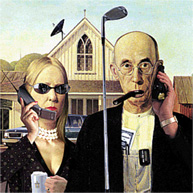
What is “Real American”? We seek to explore then generational, ethnographic, cultural, and anthropological ideals of what the word American means. From fresh apple pie to Budweiser, the Star Spangled Banner to Party in the USA, what is the modern American experience? Are we entering the sci-fi World of Tomorrow, longing for the Norman Rockwell past, or painting ourselves into an Idiocracy? If our culture is our biggest export, what kind of image are we presenting to the world? This exhibition seeks artworks that span the spectrum from whimsical to austere, nostalgic to provocative. Artworks may consist of images from popular and visual culture, contain everyday objects assembled in unexpected ways, or incorporate stars and stripes.
Awards:
$500 Best In Show
$200 2nd Place
$100 3rd Place
Two Honorable Mentions
Artists are invited to submit up to three images as jpeg files per entry. Artworks should have been created within the past three years and not previously shown in any Ann Arbor Art Center exhibitions. All media are welcome.










 Rustbelt Arts