Category Archives: exhibitions

The Art of the Story

Comics Unbound, an exhibit that examines the art and the craft of the comic, is on view right now through June 24 at Ann Arbor Art Center’s Gallery 117. The show  aims to illustrate the process through which comics, both in short and longer form, are created.  It “reveals what is usually an invisible narrative in comics–the journey from artist’s vision to clear transmission of meaning. ” according to jurors and comic artists Jerzy and Anne Drozd. The exhibition contains original drawings by cartoonists who will appear at the Ann Arbor Comic Arts Festival to be held at the Ann Arbor District Library, June 18 and 19, 2016.
oldbuck-mid-narrative
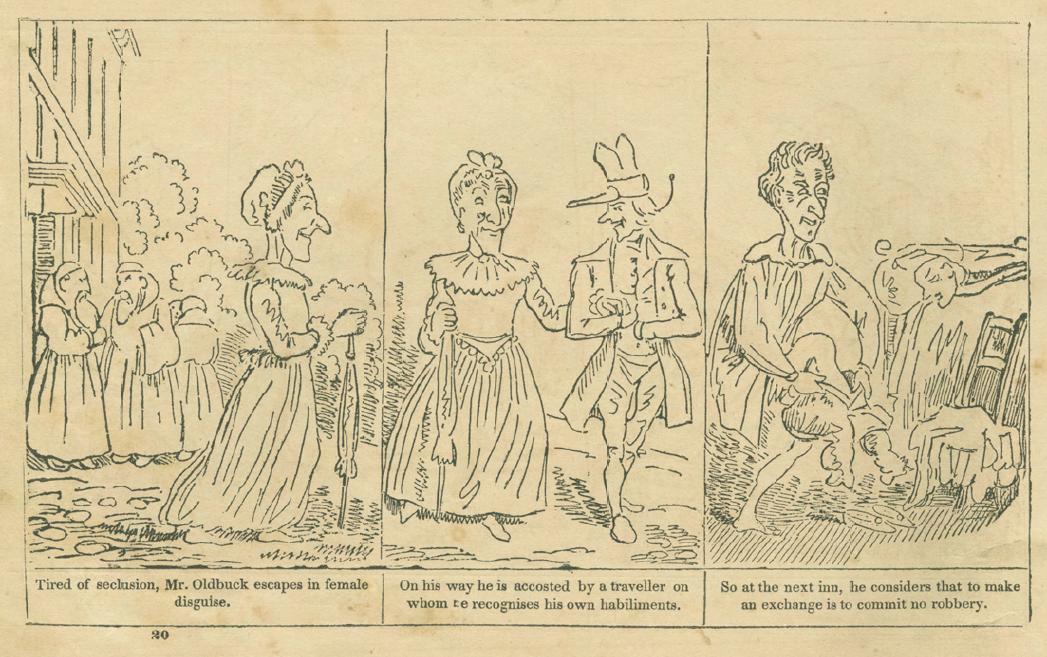
The Adventures of Obadiah Oldbuck

Ever since humans began making marks on flat surfaces, visual storytelling and the interplay between picture and text  has been an important part of western art history.   From neolithic cave painting  to Egyptian hieroglyphs to medieval panel painting, the extent to which pictures and text cooperate to tell a story has  depended on the literacy (sometimes more, sometimes less) of the general population. The invention of movable type in the mid-15th century in Europe revolutionized literacy and consequently, visual storytelling. Once most everyone could read, the path was paved for the first comic book, generally thought to be The Adventures of Obadiah Oldbuck in 1837. From there the scope and reach of comics has only increased, until now there is a whole section in the New York Times Review of Books devoted to graphic media. Numerous superhero movies based on comics  appear every summer  and Fun Home,  a musical adapted from a graphic novel is currently running on Broadway.
comic 1 rafael rosado
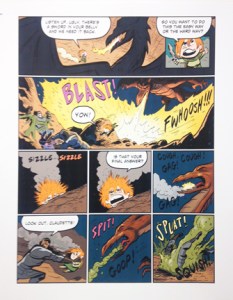
Dragon Beware by Rafael Rosado

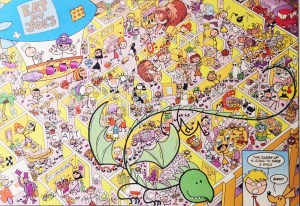
Rather than dwelling on the history of comics though, this exhibit is organized to convey an idea of  how comics  are produced: from script and hand sketched storyboards, to drawing and coloring of the finished comic, with  printed versions also on display. The show also gives a fair idea of the range of subject, mode of visual expression,  variety of intended audience and level of literary ambition currently available to this medium. The pictorial styles on display range from the intentionally rudimentary but elaborately composed stick figures of Matt Feazell’s Too Much Help to the the 1950’s-retro washy ink drawings of  Apooko by Mike Roll to the classic super-hero comic style of Tom Mandrake in Creeps.  The subjects likewise range from personal  and autobiographical (El Deafo by Cece Bell) to comic myth (Dragons Beware by Rafael Rosado) to historical (Feynman (Tuva) by Jim Ottovani and Leland Myrick ).  And the literary language from one comic to another  is just as varied  as the pictorial expression.
comics 11 mat feasell too much help
Too Much Help by Matt Feazell

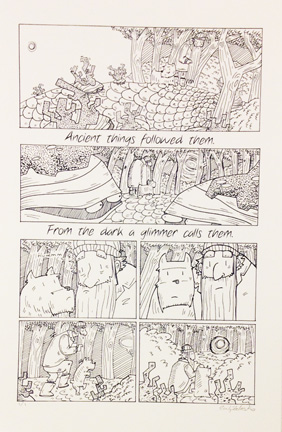
All of the artists in Comics Unbound display impressive levels of drawing ability personal to their individual style and loads of storytelling originality. A particular favorite of mine was Old Man, Dog and the Ocean by Emily Zelaszko. Her drawings are deft and idiosyncratic and her compressed language rises to the level of poetry. I also especially liked Mike Roll’s Apooko drawings and Carolyn Nowak’s Nichols Arboretum  but this probably reflects my own personal taste for certain drawing styles rather than any defensible aesthetic preference.

The conclusion I draw from Comics Unbound is that comics,  while they contain visual media, are not primarily a visual art. Rather they are more literary in nature, with visual augmentation, and their narrative strengths lie mostly in the area of dialog.  This might explain the frequency with which comics are developed into movies.  The storyboards in this exhibit certainly have a cinematic quality.  It seems to me that as an art form graphic novels and comics have most in common with  theater and film. They are meant to be consumed as literature or performance, rather than to be contemplated as fine art paintings and drawings.
comics 4 zelasko old man, the dog and ocean
Old Man, Dog and the Ocean by Emily Zelasko

The great advantage of comics over film however, is in the personal nature of their content and the relative ease with which the artist can translate private stories and concerns into a public medium without the necessity for elaborate technical support. The comic artist can, literally, express on the page anything she/he has the imagination to invent and there are far fewer practical barriers to self expression than in more public media like theater or film. The artists in Comics Unbound make full use of the broad scope of visual and literary expression that the medium offers them.

Artists in the exhibit include: Mike Roll, Emily Zelasko, Rob Stenzinger, Carolyn Nowak, Zack Giallongo, Cece Bell, Rafael Rosado, Ben Hatke, Ruth McNally Barshaw, Samantha Kyle, Cyndi Foster & Jeramy Hobbes, Jim Ottaviani, Matt Feazell, Dan Mishkin & Tom Mandrake.
Those Who Can…Also Teach

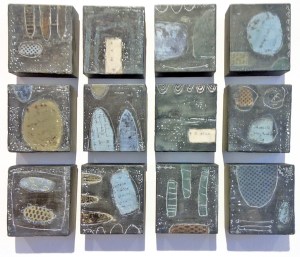
It’s a well-known fact that few visual artists working here in the Rust Belt have a realistic hope of making a living exclusively  from selling their art. So many find themselves  teaching to make a living while also trying to keep up their studio practice and actively showing their work. This requires energy, dedication, resourcefulness and maybe an ability to do without a full night’s sleep. The show currently in Gallery 117 displays the diverse skills of the hardworking  artists who give instruction at the Ann Arbor Art Center, from printmaking to painting to ceramics to animation and more.  In a show of this kind the technical  mastery of each artist is on display, and the artworks have to be enjoyed for their individual charms rather than appreciated in relation to an overarching theme. The level of skill on display is impressive, as one would expect from an instructional staff that is tasked with teaching the technical aspects in their area of expertise.

aaac heather accurso
War Baby by Heather Accurso

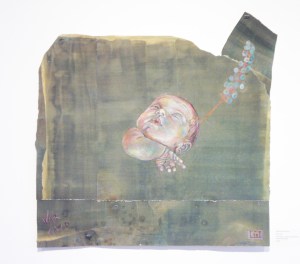
I came to the exhibit already knowing the work of some of the artists represented, among them Heather Accurso. I’ve liked Accurso’s drawings ever since I discovered them at Packer Schopf Gallery in Chicago. Yet another MFA graduate of the School of the Art Institute of Chicago, she is a skilled draftsman who employs the image of a baby repeatedly– possibly  obsessively –in her precise and surreal drawings.

Another artist with whom I was already familiar and whose work I like is encaustic painter Beth Billups.  Her charming, childlike compositions occupy the aesthetic space between innocence and sophistication.  I find the waxy surfaces and subdued pastel palette and the formalized but allusive shapes immensely appealing.

aaac beth billups small matter
Small Matter by Beth Billups

Several other artists with whom I was not previously acquainted also caught my eye. Painter Brian Skol displays a really impressive level of technical skill in his paintings and their mood put me in mind of Thomas Eakins. Rebecca Pugh’s landscapes made me think of plastic in new ways, and I found Deb Scott’s claymation animations fun and entertaining. Marc McCay’s small prints reminded me of how much I like the economy and elegance of black and white.

There are 19 artists in this exhibit and I’m sure I didn’t give each the attention he/she deserves, but the Instructor Show is open until June 4, so you will have the opportunity to see for yourself what these artists have to teach. The exhibit includes: Heather Accurso, Morgan Barrie, Beth Billups, Payton Cook, Kim DeBord, Jerzy Drozd, Dave Dziedzic, Michael Garguilo, Chris Kamykowski, Angela Lenhardt, Emily LoPresto, Marc McCay, Rebecca Pugh, Deb Scott, Claudia Selene, Larry Sekulich, Brian Skol, Daria Paik White

For more information about hours and directions go here


Rossi/Fitzpatrick in Chicago

I consider it my job to report on art and artists in Southeast Michigan and Northwest Ohio, so I don’t usually cover the art scene in Chicago, though it’s technically in the Rust Belt. Chicago artists get plenty of coverage after all.  But I know many artists and art lovers will be going to Chicago this summer from the Detroit area, and I want to alert you to two important shows that are not in the major downtown museums but are easily reached by taking the Red Line to the Fullerton stop.  As you get off the train, go downstairs;  DePaul Art Museum will be right next door where you will get two amazing art experiences for the price of one (actually, admission is free).Rossi_Eye Deal_1974_med

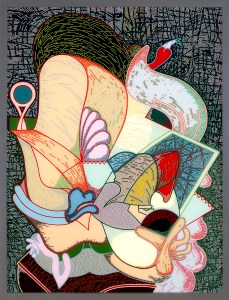
First of all, Barbara Rossi’s amazing show of  paintings, entitled Poor Traits, is installed in two upper galleries of the museum, along with her photos in  a smaller side gallery.  Barbara Rossi belongs to the historically important group the Chicago Imagists, and is one of the most talented of a very talented bunch. These influential artists of the 1960’s and 1970’s  put Chicago on the map of contemporary art with their diverse pop-inflected, off-beat figurative art.  Other artists from the group that you may recognize are Ed Pasche, Gladys Nilsson, Jim Nutt, Christina Ramberg, Roger Brown,  Karl Wirsum and H.C. Westerman.

Of the Imagists, Rossi is the  most elusive still-living member of the group.  I have very seldom seen even one of her  paintings on display so I’ve had to enjoy them mostly in reproduction. However, the New Museum in New York came to the rescue last fall and put together this terrific exhibit of Rossi’s works from the late 1970’s, which has now come to Chicago. The organizing principle of Poor Traits is of course, portraits (the pun very much intended in the Chicago Imagist manner). Each painting and small drawing consists of a single figure, abstract but recognizable as human.  They are icons of a sort, mysterious and quirky. Her palette of colors is most closely related to the grayed down taupes, beiges and grays of Christina Ramberg’s paintings, but with added powdery greens and blues that recall shades of  house paint, punctuated with dark red and green outlines. Each figure is painted in flat colors on a panel, then it is overlaid with plexi-glass upon which she meticulously paints tiny pinhead sized dots .  The effect is hypnotic, the dots seeming to float over the figure in a kind of 3-d halo effect. Her work is unlike that of any other artist I’ve ever seen and it’s impossible to fully appreciate in reproduction, so this is an opportunity not to be missed.

As an added bonus, the museum is handing out a  free large poster with a Rossi painting in 1:1 scale. Mine is pinned up on the wall of my studio right now.

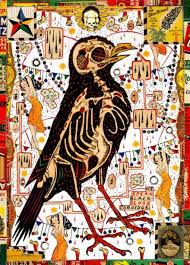
As if that weren’t enough, the museum also has on view Tony Fitzpatrick: The Secret Birds. This show of drawings, collage/paintings and prints by one of Chicago’s most popular contemporary artists is both visually and emotionally appealing. A multi-talented writer, draftsman, painter, collagist, poet, playwright and actor, the artist employs drawing, painting, found pop cultural imagery, and snippets of his own poetry to get to you on all possible levels. He has even helpfully  installed a mock studio in a small back gallery to display the materials he uses for collage, his literary sources and copies of books he has written/illustrated. alchetron tony fitzpatrick

Fitzpatrick uses the language of outsider art in his work, but I can’t say that I think he is an outsider artist.  Rather, he applies the methods and preoccupations of self-taught artists in an informed and knowing way. His choice of collage materials is resolutely  low-brow,  pulled from vintage matchbooks, cigar bands, retro 40’s pin-ups, crossword puzzles, comic books.The central image in most of the paintings is a bird, which in this context is a stand-in for the soul. Often this soul is that of one of Fitzpatrick’s departed heroes such as the writer Gabriel Garcia Marquez or legendary jazz musician Otis Clay. Death, time and memory are the dominant themes of these cheerful but macabre artworks.

Both Poor Traits and Tony Fitzpatrick:The Secret Birds are on view until August 21, 2016. For more information on the museum’s hours and location go here

.


Over the Rainbow with Shaina Kasztelan

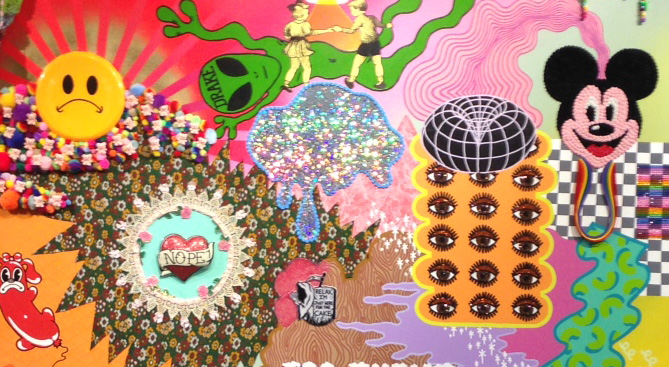
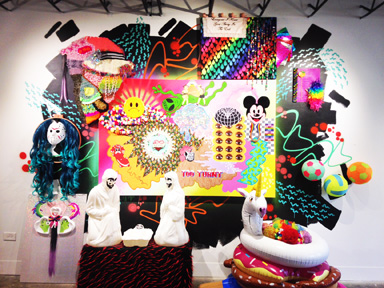
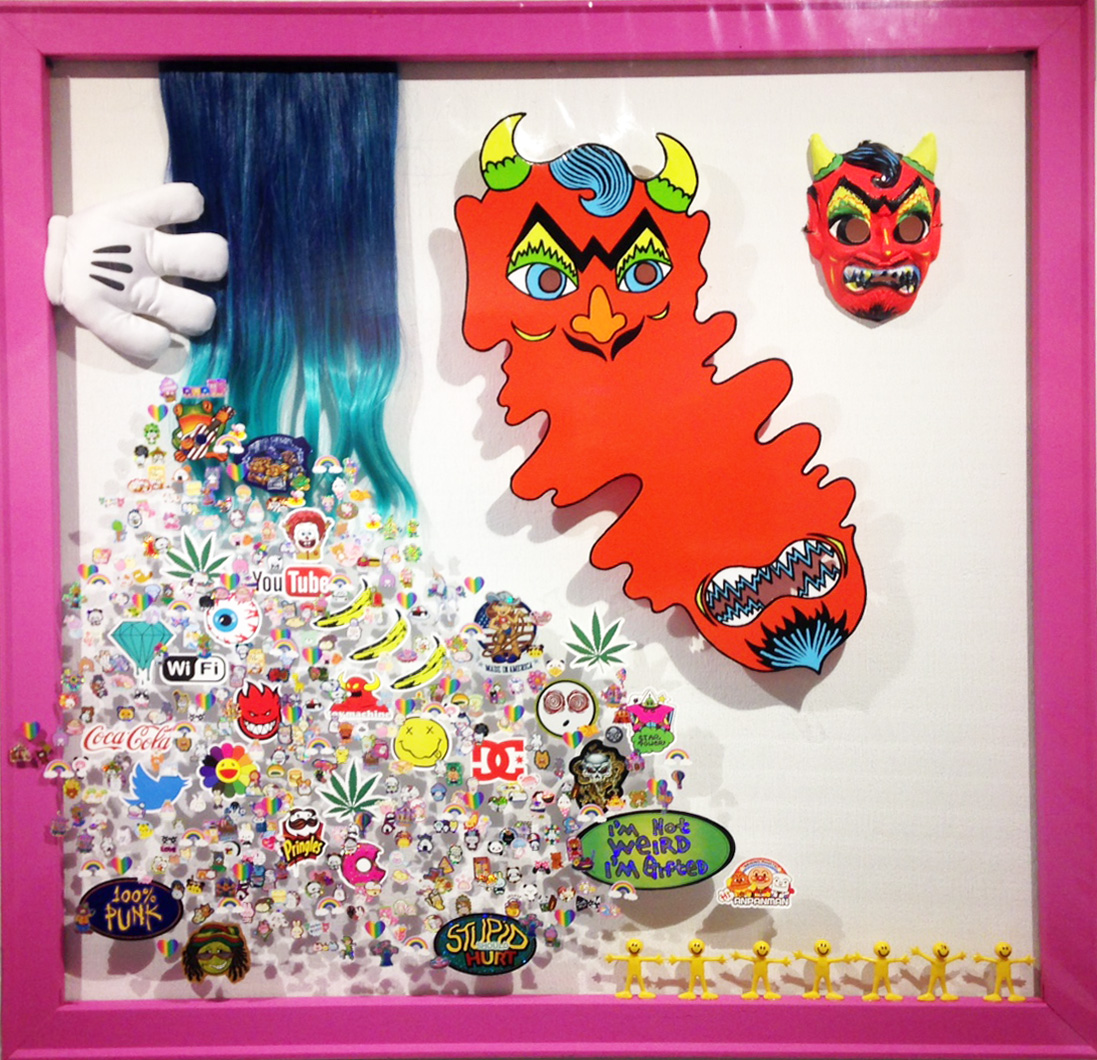
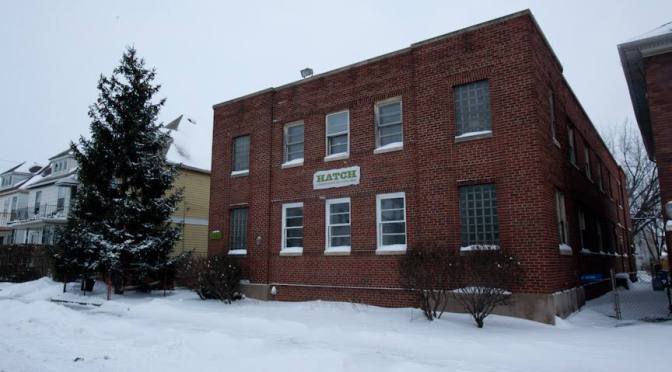
Somewhere over the Rainbow is Another Rainbow at Hatch Hamtramck is Shaina Kasztelan’s poison pen love letter to kitsch and consumerism.    This Detroit artist and recent CCS grad  seems to simultaneously love and hate the symbols and materials that she uses to create her wildly entertaining  installations, paintings and sculptures.

kasztelan1

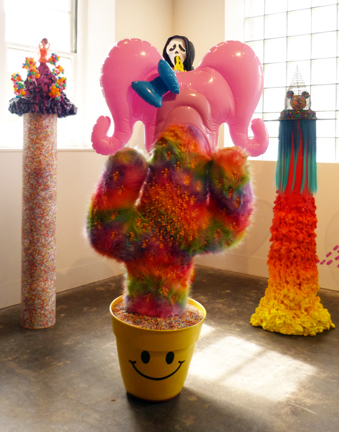
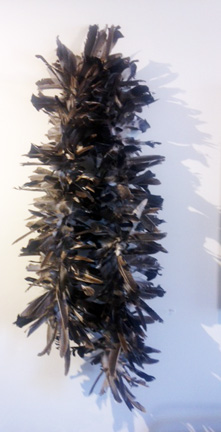
Many artists in Detroit  are enthusiastic collagists of  gritty urban substance,  their  artworks depending on the inherent material  integrity of the parts to lend credibility to the whole. In contrast, Kasztelan employs the same assemblage method but uses materials that are the antithesis of authenticity.  They are, in fact, intentionally notable for their fakeness. The color is super-sweet, the forms mass market.  She  combines polyester fur, hobby shop jewels, plastic inflatables  and synthetic hair in obsessive aggregations, reaching new heights of  over-saturated,  over-the-top  visual hysteria.

I was surprised to learn that this is Kasztelan’s first  solo show.  The work seems confident, the installation expert.   The friendly yet knowing mood of the exhibit reminds me most of John Waters’s movies with their gleeful embrace of low-brow mass culture and transgressive imagery.Kaztelan Devil

Kasztelan seems especially  at ease in three dimensions. The most assured and  ambitious work in the show, entitled The Alien with the Drake Tattoo/Dedicated to the Butterfly,  is a kind of altar (complete with Juggalo nativity) that seems to burst out of a black cloud (of depression?)  She seems less at ease in the conventional rectangular format of her paintings, which felt a bit awkward to me. But she has very cleverly circumvented this unease in The Devil’s Vibrating Smile by applying the  imagery to clear vinyl. My favorite piece was a fake fur potted plant infested with tiny toy babies and topped by a pink plastic bouffant, entitled Baby Cactus is Happy. This show made me happy too.Kasztelan revised 1

Somewhere over the Rainbow is a Double Rainbow is at Hatch Hamtramck until May 28.  For more information for hours and events go here.

Space Between Time

Newly arrived from the suburbs, Wasserman Projects art gallery is what I hope the future art spaces of Detroit will look like-clean, well lit, and elegant (and open more than once a week for 3 hours!) The museum-quality treatment that Esther Shevel-Gerz’s  Space Between Time receives from the gallery  convinced me that I needed to look more carefully at her work than I would otherwise be inclined to, since I’m not a great fan of conceptual art generally.

Esther Shevel-Gerz  employs a visual idiom that I would call high academic. She combines video, art photography and text to convey her recurring themes: the fugitive nature of memory, the inexorable passage of time and inevitable loss. Although they are a little forbidding at first approach, her art works are actually fairly straightforward   (with one exception which I will get to later). They are a kind of institutional art, each one having been installed originally for a  specific  museum, school or cultural institution. Shelev-Gertz’s works are related very closely to the sites for which they are conceived and often incorporate the people who work at or attend  that institution.  You, as the viewer, are called upon to imagine them installed in that setting in order to appreciate them fully.

Esther Shevel-GerzThe  most accessible and appealing work, to my mind, was created for the Municipal Library of Vancouver and is entitled The Open Page. It is a suite of high resolution, large-format photos of antique rare books selected by the librarians from the locked stacks of their library.  Each one is  tenderly held in the disembodied hands of its keeper. The reverent love of the librarians for these beautiful objects is palpable.
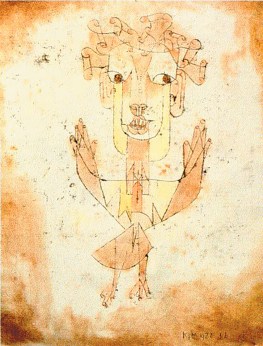
The most conceptually  challenging work,  Inseparable Angels, is a quasi-installation. A video with audio, two black and white photographs, two color photos, a clock that runs both forward and back,  and  accompanying text are displayed along a back wall of the gallery.  All of this was  originally installed in the upper story of a house at the Bauhaus University in Weimar. In Inseparable Angels Shevel-Gerz imagines a home for Walter Benjamin, a prominent philosopher who committed suicide in 1940 while fleeing the Nazis. The video records a 15 minute  trip from Weimar to Auschwitz. The taxi driver recounts various “sights” along the way,  all of which appear only in his memory, as they no longer exist in fact.  The 2 adjacent color photos represent  sites where now-absent places once stood.

Paul Klee: <i>Angelus Novus</i>, 1920
Paul Klee: Angelus Novus, 1920

The accompanying text refers to his journal, Angelus Novus.  This was also the title of a Paul Klee painting of the same name (which Benjamin owned). In spite of its sweet appearance, this angel was far from benign. For Benjamin this was the angel of history:

 “His face is turned toward the past. Where we perceive a chain of events, he sees one single catastrophe which keeps piling wreckage upon wreckage and hurls it in front of his feet. The angel would like to stay, awaken the dead, and make whole what has been smashed. But a storm is blowing from Paradise; it has got caught in his wings with such violence that the angel can no longer close them. The storm irresistibly propels him into the future to which his back is turned, while the pile of debris before him grows skyward. This storm is what we call progress.”

The work that may resonate most with a Detroit audience though,  is Describing Labor, created for the Wolfsonian Museum in Miami Beach, Florida. A split screen video shows interviews with the museum personnel, each of whom has chosen an artwork that shows people engaging in manual labor.  The interviews create a peculiar kind of double vision; mind workers talking about manual workers as if they are anthropologists talking about a concept of labor that exists now only as a kind of historical artifact. In a nearby vitrine, the point is driven home even more clearly. Hammers have been cast into clear glass, useful tools no longer having a use.

In the end, to my surprise, I found I liked Esther Shevel-Gerz quite a lot.  Her cool, conceptual approach allowed me to thoughtfully contemplate themes that are always in the back of the mind but rarely get our full attention.  Her work is also a reminder of the importance of institutions such as museums and libraries.  They are repositories of our collective memory that allow  us to recall what we might otherwise forget. And she introduced me to Walter Benjamin, who I am coming to know better as I read his essay The Work of  Art in the Age of its Technological Reproducibility (more of a page turner than you might think from the title.)  So…thank you Wasserman Projects!

Space Between Time is on view until July 9.  The gallery, located at 3434 Russell Street, is open Wednesday-Saturday. Parking is available on site. For more information go to http://wassermanprojects.com/


Did you Blink?

… If you did, you missed it.  I didn’t think it was possible for the hours at Whitdel Arts to get shorter. But I was wrong. Whitdel Arts, like many volunteer-run art spaces in Detroit, keeps its doors open only on 1 day a week for 3 hours per month-long show, a total of 12 hours. I have often struggled to get to Whitdel’s  well-conceived and well-installed shows during that window. But the  most recent show, One Year Later: Work by Tisch Mikhail Lewis was open only for 5 hours total, on Friday, May 13 and Saturday, May 14. This pop-up exhibit was held in a recently renovated and still empty craftsman-style  house on Commonwealth Street in Detroit. More about that later.

The stated theme of  One Year Later is our societal obsession with body image, weight control and conventional ideas of beauty.  Lewis says, “I use my work as a way to make sense of the world around me by deconstructing my experiences and examining them in terms of sociological theory pertaining to identity, body image, race and intersections between the three.”

These predominantly blue and yellow figures, mostly painted on raw canvas, didn’t strike me as being hard-edged political statements though.  Instead I found them to be lyrical and virtuosic figure studies, deftly done, and  quite pretty. The paintings are   relatively small scale, which gives them an air of intimacy that I enjoyed even though it undercuts somewhat the stated theme of the show.  It’s fashionable these days to make a political point with one’s art, but it seems to me that lovingly created and well drawn traditional figures  have value too.

whitdel 2

Now, as to why Whitdel Arts is open during shortened hours in a pop-up gallery. I have some bad news:

Through no fault of their own, the collective recently found itself out on the street following a sudden  notification from their landlord that their presence in the space was no longer welcome. While I  understand that nothing lasts forever, and that a landlord who has been generous in the past is under no obligation to be generous in perpetuity, the behavior of Southwest Solutions was abrupt and shocking. It also points to a growing hazard for non-profit collectives in the city. As  higher real estate prices come to Detroit, there will be increased economic  pressure to displace worthy but underfunded arts organizations of all types.

In spite of losing their  Hubbard Street space, the Whitdelians have vowed to soldier on, and are currently planning to maintain an active schedule of pop-up exhibitions until they are able to secure more permanent gallery space. So, for now,  it will be a little more difficult to keep track of Whitdel events.  You can go to the Whitdel Arts page on  FaceBook for updates here.

Hatch Hamtramck is 10 Years Old

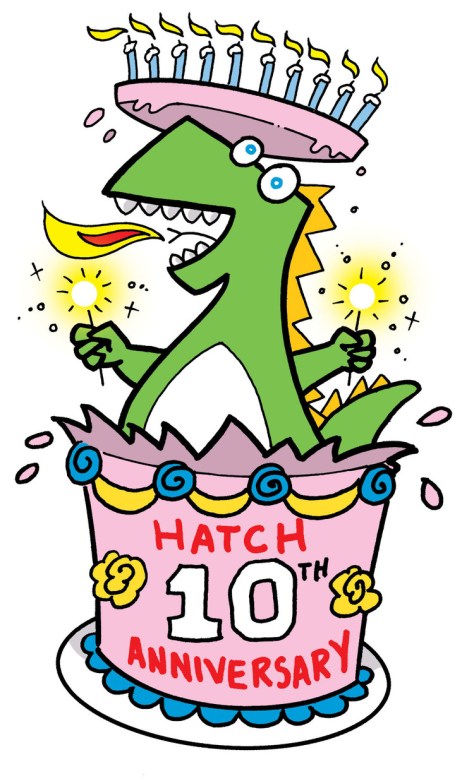
It doesn’t seem possible,  but time flies and Hatch Hamtramck has been around now for ten years.  In celebration, the non-profit studio and gallery has organized its tenth annual juried exhibit Hatchback 10. This  comprehensive  exhibit, juried by Detroit art personality James Dozier, features 55 Hatch artists and is on display through April 30.

A celebratory 10th Anniversary Party will be held 6-10 on Saturday, April 30 in the Gallery. The event is free and open to the public.

Hatch10-1
Dumped for a Stripper by Erin K. Schmidt

Hatch is the brainchild of Hatch president Christopher Schneider and Erik Tungate, Hamtramck’s former Director of Community & Economic Development. They saw a need for an artist community that would promote Hamtramck in a positive way, where artists could pool their resources to challenge each other and reach out to the greater community.

United by the shared mission of Education, Expression and Exhibition, the group rapidly gained followers and supporters. Regular meetings were held in community centers, local businesses and artists’ studios. In 2007, Hatch achieved 501[c]3 nonprofit status and developed a full calendar of events. Within its first year of existence, Hatch founded the Detroit chapter of Dr. Sketchy’s Anti Art School, represented Hamtramck artists at 2 art fairs, and hosted concerts, critiques, educational workshops and more.

Hatch purchased the old police station at 3456 Evaline from the City of Hamtramck in 2008. For the next four years, renovations were made, concurrent with fundraising and maintaining a full events schedule. A new roof and central heating system were made possible through grants and crowd sourcing campaigns. Volunteers put in countless hours to help convert the former police station into a space for making and exhibiting art.

hatch10-3
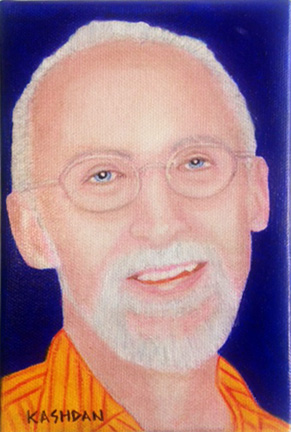
Portrait of Jack Summers by Deborah Marlow Kashdan

Hatch Gallery officially opened in April 2012. Upstairs, studios became available for rent in July and were at full occupancy by the year’s end. Classroom space was finished in March 2013.


“Them” at Butter Projects in Royal Oak

Luxury, identity, class, perversity, carnality, playfulness… Royal Oaks’ Butter Projects has stirred it all together to create a thoughtful visual feast that describes what lies on the surface and what lies beneath.  “THEM” is loosely framed around portraiture, commonly defined as a representation or likeness of a specific individual, but each artist has gone far beyond the mere creation of a likeness to portray the unseen  reality below the surface.

Thirty-three beautifully rendered black and white gestural portrait studies by William Irving Singer anchor the show against an meticulously painted blue brocade background.  The portraits, which are made with black acrylic on coarse un-primed canvas, comment ironically on the society portrait as a signifier of wealth and importance. The lone likeness by Singer which features color, entitled Some Sort of Lunch Line, seems to portray a member of the have-not class who nonetheless sports a kind of jaunty elegance. somesortoflunchline

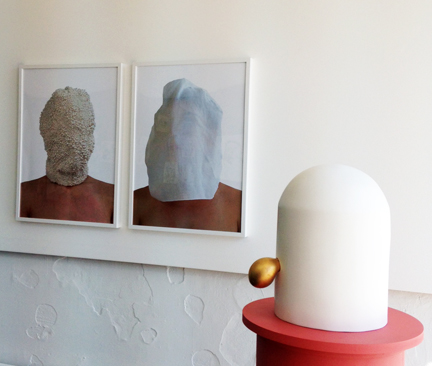
Works by Lauren Kalman consist of fetishistic photographs of  hooded women. The effect of these photographs is ominous and seems to indicate that the woman portrayed is engaged in some kind of luxurious pearl-encrusted sex play. She is not powerless, but she is immobilized.

The photographs are accompanied by formal hood-like clay or pigskin sculptures, some with corks or objects stuffed in the apertures where one would expect to find eyes or mouths. They are both humorous  and disturbing.

But if the crime is beautiful

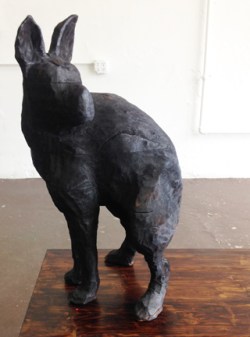
As if to add some lightness to this otherwise serious exploration of the self, Butter Projects has included three-dimensional work from artist Kat Burdine. These canines are engaged in doing what dogs do and doing it with abandon: pooping, groveling and licking…no inner angst here. Entitled “Strays” these  chunky life-sized wooden creatures project a kind of joy in spite of  their displacement.

butter dog

During the run of the exhibition, Butter Projects will hold open hours Saturdays and Sundays from 1-3pm. Additional hours can be made by appointment. Them will be on exhibit until May 7, 2016

Butter Projects is an artist run studio and exhibition space. For more information contact Alison Wong butter.projects@gmail.com

Butter Projects, 814 W. 11 Mile, Royal Oak, MI 48067


Borders Exhibit Opening March 3

Letts_The Borderlands (painting)

I am delighted to be included in the upcoming juried exhibition Borders,  hosted by River House and the Owens Community College  Center for Fine and Performing Arts.  The opening reception will be held on Thursday, March 3, from 6-8.  The juror, Sarah Rose Sharp will be speaking at the  opening reception.  She is a 2015 Kresge Literary Arts Fellow for Arts Criticism.

The exhibit will run March 4-31 at the Walter E. Terhune Gallery in the Owens Community College Center for Fine and Performing Arts, located at 30335 Oregon Road, Perrysburg OH 43551. Check here for more information.

A total of 17 artists have been selected to exhibit 27 pieces of work in the juried exhibition. Artists were asked to consider these questions in submitting their works: Where do we find borders and how do they shape us? Why do we embrace or reject them? When does a unifying contour become a divisional line?

The selected artists: David Burke – PA, David Cuatlacuatl – IN, Mary Fortuna – MI, Maureen Joyce – PA, Lindsey Landfried – PA, Yusurf Lateef – OH,  K.A. Letts – MI,  Zach Lihatsh – IL,  Mary Mazziotti – PA, Laurenn McCubbin – OH, Sidney Mullis – PA, Gabrielle Roach – IN, Whitney Sage – OH, Jina Seo – IL, Meagan Shein – MI, Kathryn Shinko – OH, Jessica Tenbusch – MI

Hatchback 10 Call for Art

Hatchback 10 image

Hatch Gallery and Studios, located at 3456 Evaline in Hamtramck, Michigan, has issued a call for artists for Hatchback 10, its annual art exhibition and sale. The due date for applications is March 7, with artist notification on March 14. There is no fee.  The Juror is James Dozier, an accomplished multimedia visual artist represented by Ferndale’s Batista Gallery. Mr. Dozier reports via e-newsletter on art exhibits and cultural events throughout the Detroit area.

There is a limit of 3 images per artist; all media are accepted. All artwork must be for sale. HATCH will take a 30% commission from artwork sold during the exhibition. Entries will be judged from digital files. Images should be about 800 pixels at their longest side. Include the artist’s name in the digital file name.  Entries may be submitted via email or on the Hatch website.  For more information and to apply,  go to: http://www.hatchart.org/hatchback

Hatchback 10 will be on view in the Hatch Gallery from  April 2 to April 30. An opening  reception will be held on April 2 from 6-10 p.m. Gallery hours: Saturdays, 1-6 p.m., with participating artist talks weekly on Saturdays at 2 p.m.