All posts by K.A. Letts

K.A. Letts is a painter living and working in the metro Detroit area.

Karin Wagner Coron

wag1-cropped
Green Fields

From Above,  a small collection of paintings on view until November 26 at WSG Gallery in Ann Arbor,  shows  Karin Wagner Coron continuing her ongoing exploration of the Midwestern landscape.  Working with photos taken from an airplane, this accomplished contemporary artist has created a select group of views of Midwestern fields and vistas  punctuated and bounded by the fresh water lakes and rivers of the region.

These birds-eye views emphasize the agricultural  geometry of Michigan and Ontario fields, delivering the illusion of flying over  the limitless sweep of land that is the Midwest.
wag2-cropped
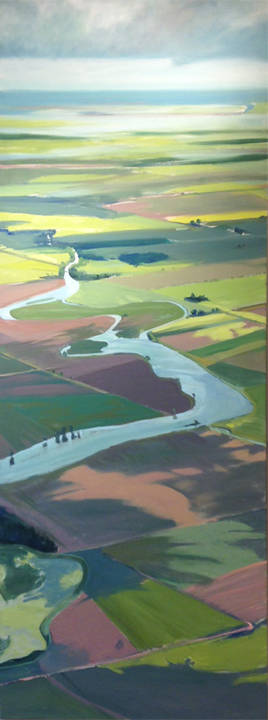
Thames River, Ontario, Canada

Many of the landscapes feature a kind of vertiginous diagonal composition, as if she is looking from the window of a steeply banking airplane (which in fact she is). She describes her process:

“I use photography as a basis for my compositions, to capture a particular time of day, interesting light  or composition.  I perceive and interpret nature while constantly finding a new palette or color scheme to match mood and feeling.”

Landscape paintings from an aerial point-of-view are nothing new, of course. Chinese painters from the Tang Dynasty onward painted nature as if from a neighboring mountaintop,  each landscape  a transcendent  retreat from the banal and everyday. And painters of the Hudson River School such as Thomas Cole and Frederic Edwin Church painted landscapes from overlooks that emphasized the limitless grandeur of the newly discovered American West.

In contrast to the escapist romanticism of Chinese landscape painters and the romantic imperialism of American painters of the West, Coron’s aerial landscapes revel in the orderly section and bisection of the land, with farmers’ fields cut by dirt roads and softened at the edges by hedgerows. This overhead perspective is especially appropriate for topography that is essentially flat. Pattern and color measure the paintings’ depth with the slightly diagonal compositions of many of the artworks leading us into the painted distance.

Coron’s vision of nature only lightly ordered by humans contrasts with that of other noted contemporary landscape artists such as Yvonne Jacquette and Rackstraw Downes, who emphasize the built environment over natural features and imply human habitation and activity. Coron, being a Great Lakes artist,  also gives equal weight to the meandering of rivers and the inchoate shadows of clouds passing overhead even as she  accepts the tamed land below her.

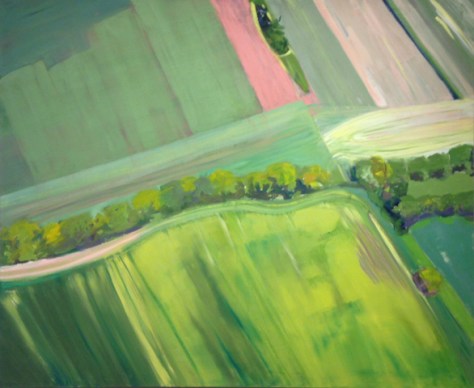
In the end, although these paintings clearly reference the Midwestern landscape they can also be appreciated for their more formal qualities. The color palette she has chosen for this series, with its acid yellows, juicy greens, muted pinks and aquatic blues, is more expressive than descriptive. Coron invites us not only to enjoy these paintings as descriptions of regional topography and atmosphere, but also to appreciate their sophisticated abstract sensibility.
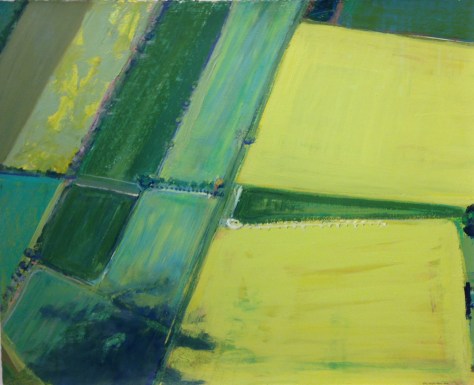
wag4-cropped
Yellow Green Fields #1

Karin Wagner Coron has been exhibiting her paintings and prints  professionally since 1992. A graduate of Eastern Michigan University with a BFA in painting, she is  owner and manager of Format Framing and Gallery in Ann Arbor,  and is a member of WSG Gallery, also in Ann Arbor.

For more information about WSG Gallery and this exhibit, go here.
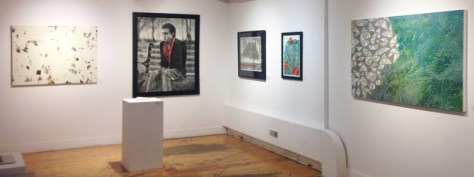
 

Ann Arbor Art Center All Media Exhibit Awards

am-install-bannerThe winners of prizes for Ann Arbor Art Center’s 94th All Media art exhibit Free Wet Hugz which opened October 14 have been announced.  They are:
Jean-Paul Aboudib (Chaos In Captivity), Louis Boyang (Mother’s Day), CJ Breil (Conduct Becoming: Surveys #3 and #4), Yuling Chuang (Exist, Coexist: Harmony 2), Analicia Honkanen (Dallying (Free Wet Hugz), Nathan Margoni (No Fear),  Robert Mirek (No. 681), Julia Pangborn-Harley (A Brown, Gravelly Road Framed by Barren Plants), Cristin Velliky (Hull), Yuge Zhou (Green Play)

The award winners were chosen by Juror Paul Kotula, who has worked as a gallery director for Pewabic Pottery, Swidler Gallery, REVOLUTION (Detroit and New York) and paulktoulaprojects. Working with an international list of artists, he has formed over 200 solo and group exhibitions pertinent to the field of contemporary art and visual culture.

For my review of the show in Pulp Magazine go here.


Quiet Glass in Toledo


hush-ex-static-puddle
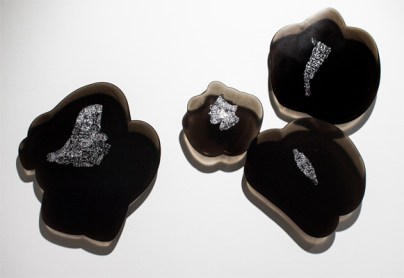
Static Puddle by Jessica Jane Julius

When someone says “art glass” do you think immediately of the colorful, often whimsical and crowd-pleasing objects that are staples of  art fairs and craft festivals? Well, think again.

HUSH.ex, a  group show of four artists from Philadelphia’s Tyler School of Art, on view until November 4 at River House Gallery in Toledo, will re-order your preconceptions of what glass as art can be and do.

hush-ex-tall-vase-with-thorny-vine
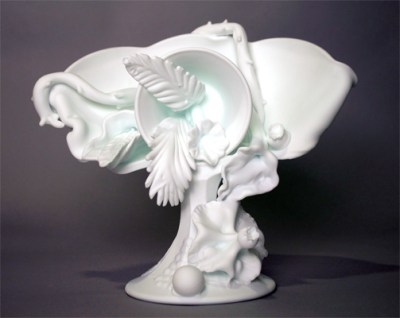
Tall Vase with Thorny Vine by Amber Cowen

Working within a narrow range of colors and a broad array of glass types, Megan Biddle, Amber Cowan, Jessica Jane Julius and Sharyn O’Mara have filled the gallery with a collection of visually and conceptually challenging work that refuses the flashy over-stimulation of the digital age. The easy appeal, saturated colors and fluid shapes of conventional art glass have been replaced by a more austere vision that is expressive of solitude and silence. The artworks are predominately black, white and shades in between;  the types of glass include production milk glass, airport grade glass reflector beads,  found and second-life glass and more.  The artists heat, crack, fuse, burn and pour their way to artworks that push the medium of art glass well beyond its previous aesthetic borders.

Jessica Jane Julius’s Static Puddles are made by pouring black matte glass over shards of canework. The story of their production is evident in the jagged centers of black and white surrounded by the  gloppy shape of each piece, but that is secondary to the lyrical appeal of these weightless black blooms.  In another instance of prosaic material transcended by the poetic, Julius has applied airport grade glass reflector beads suspended in paint on four panels to create a wavy, translucent river that flows across the wall of the gallery. The title of the piece is Absorption.

hush-amber-cowan-milk-glass-installation
Milk Glass Installation by Amber Cowan


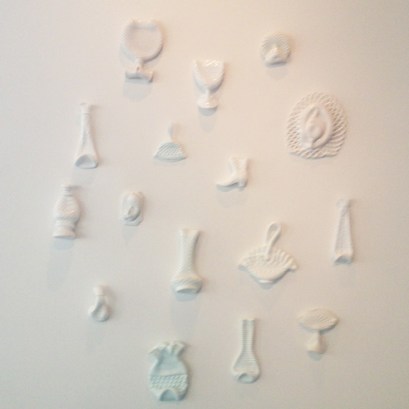
Recycled, up-cycled and second-life glass provides the raw material for the works of Amber Cowan.  Her installation of commonly recognizable milk glass objects, heated and deformed, transforms these everyday vessels into ghostly memorials to their humble use. In Tall Vase with Thorny Vines, Cowan has heated a production vase, pierced it and collaged ceramic plants into it, shaping it into a matte white still life that is both familiar and surreal.

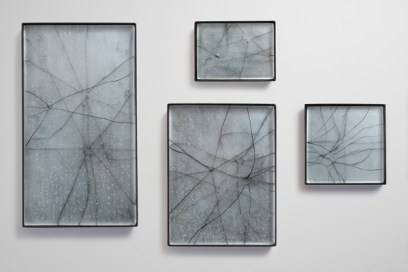
The work of Megan Biddle focuses on process-driven work  that emphasizes the unique qualities of materials and their response to outside forces such as time, growth, erosion, breakage. (In addition to her glass work, she produces installation, sculpture, drawing and video.)  Her Further for Now  series examines the way that layers of cracked glass can create a kind of line drawing on a hazy, semi-transparent field.

hush-ex-furtherfornow-1
Further for Now 1-4 by Megan Biddle


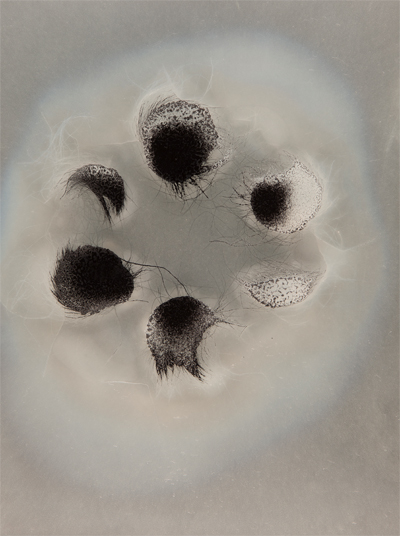
Dog hair, optical fiber and typewriter tape are the eccentric components that characterize the work of Sharyn O’Mara.   Particularly prominent in this exhibit are her carbon burn-out “drawings” on glass.  These hair-on-glass process pieces are abstract, yet often seem to reference seed pods or plants.  They have an ethereal quality, as if they might disappear into thin air, blown away by fugitive winds.

hush-ex-botanical-4
Botanical IV by Sharyn O’Mara


The glass art that is featured in HUSH.ex is neither easy nor pretty nor decorative, but satisfies on a deeper level.  These four artists demonstrate that there are many unexplored avenues for discovery in this medium that is so central to the regional aesthetic. They point the way to a creative trajectory in art glass that is cerebral, experimental and conceptually rigorous.

HUSH.ex is the second in a series of museum-quality exhibits organized by Contemporary Art Toledo, a collaborative partnership of gallerist Paula Baldoni of River House Gallery with Brian Carpenter, Gallery Director at the University of Toledo.  (Their first exhibit was Beautiful Pig). The goal of CA+ is to  provide a showcase in the Toledo area for provocative and groundbreaking  contemporary artwork by nationally known and regional artists.

For more information about HUSH.ex and River House Gallery hours go here

Ann Arbor Artists at ArtPrize 8


sunset-m-1896
Sunset, Monmartre, 1896 by Peter Warburton

I reviewed five Ann Arbor artists who participated in ArtPrize 8 this year in Pulp Magazine recently. They include a glass artist, an artist who “paints” in duct tape, a team that made a giant, LED festooned tree, a muralist, and a talented observer of the human eye.  To read about them–and ArtPrize 8– go here

Big Sculpture


hp-kiwi-robert-onnes
Kiwi by Robert Onnes

The Detroit art scene is in the midst of changes. Over the last year or two, shiny new galleries like Wasserman Projects, David Klein  and Gallerie Camille have established themselves in downtown and midtown, with regular hours and regular shows. But for those of us who like to hunt for art in less established–and less gentrified–corners of the city, there are still new discoveries to be made.The Factory at 333 Midland in Highland Park is one of them.

This rambling, 23,000-square-foot industrial complex, formerly the Lewis Manufacturing and Stamping plant, was recently purchased by New Zealand-born sculptor Robert Onnes and provides studios  for himself and 17 other artists. The space is still in the process of being upgraded–they are raising money to put in heat this winter– but that hasn’t stopped them from putting on an ambitious group show that is installed throughout the  main building and its nearby, newly-opened exhibit gallery. Big Sculpture@The Factory includes work by over 50 artists and displays more than 200 sculptures and installations, both large and small. It is open on weekends only until October 22. Music, food, drink, and scheduled artist talks are thrown in for good measure. On the day I attended there were plenty of visitors taking it all in.

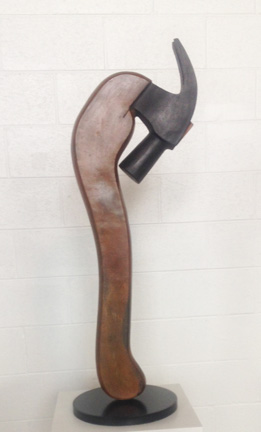
hp-melancholy-hammer
Melancholy Hammer by Adnan Charara

Artists in Big Sculpture range from emerging to eminent, with a few of my favorites represented by some of their most ambitious work.  Mega Bat, by Tim Pewe, has a wingspan of over 17 feet, and hovers overhead in the studio of the owner, Robert Onnes, who makes visually massive but lightweight formalized figurative sculptures. His Kiwi, a birdlike shape that rests outside the building in an open courtyard with other large scale sculptures, elegantly references his land of origin.

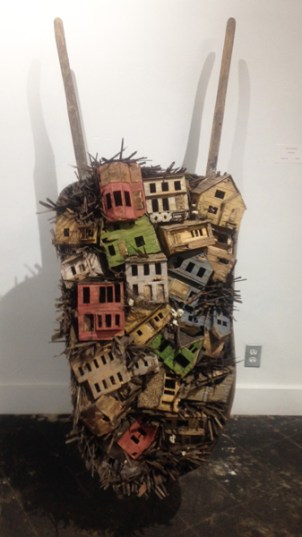
Some of the smaller works in Big Sculpture are displayed in a room  adjacent to the main studio,  and include the delicate, toy-like yet slightly sinister assemblages of Catherine Peet.  Wall sconces made of old metal toy trucks by Alvaro Jurado light the hallway. One of my favorite pieces in the show, Hell in a Handbasket by Sandra Osip, leans up against a wall nearby.  A collection of tiny houses made from scraps of demolished Detroit homes is piled high in a wheelbarrow, stacked and ready to be discarded like so many of the city’s derelict structures. It’s both playful and sad.

hp-hell-in-a-handbasket-by-sandra-osip
Hell in a Handbasket by Sandra Osip

It’s impossible to describe all of the imaginatively conceived and well-made works in Big Sculpture.  In spite of the rough surroundings, the overall mood of the exhibit is light-hearted and inventive.  There were plenty of visual puns like Melancholy Hammer by Adnan Charara and Chris Zagacki’s Hook, Line and Sinker. Single Digit, by Rick Cronn, literally gives us the finger.

The new exhibit space in the smaller building adjacent to the main structure houses yet another trove of excellent work; Inuit Spirit by Tom Phardel and Beings Connected by Charles McGee were standouts.  A newly constructed balcony  wraps around the periphery of the gallery.  It provides a more intimate venue for smaller works like Architectural Exploration by Leah Waldo, one of a series of block-like objects of cast glass, steel and low-fire soft brick.  Also  notable are the felt and wood constructions of  Susan Aaron-Taylor. I particularly liked Fears, which shows a mouse-like creature trapped in a ribbed structure.  Ann Smith, one of the artists I met during my visit, told me that other exhibits will be scheduled in the new gallery space, though there is no published schedule yet.

There’s still time to see Big Sculpture! The exhibit is on view until October 22 and by appointment.  For more information and to check on scheduled events,  go here.

Artists exhibiting in Big Sculpture: Susan Aaron-Taylor, Anita Bates, Richard Bennett, Peter Bernal, Robert Bielat, Betty Brownlee, Coco Bruner, Scott Campbell, Doug Cannell, Cruz Castillo, Hannah Chalew, Adnan Charara, Christina Cioffari, Leslie Cislo, Rick Cronn, Joe Culver, Olayami Dabis, Pam Day, Sergio De Giusti, Todd Erickson, Mark Esse, Eric Froh, Sean Hages, Al Hebert, Alvaro Jurado, Ray Katz, Dawnice Kerchaert, Eno Laget &Jerome Brown, Terry Lee Dill, Jay Lefkowitz, Lindsay McCosh, Charles McGee, Steve Mealy, Robert Mirek, Carlos Nielbock, Israel and Erik Nordin, Robert Onnes, Sandra Osip, Catherine Peet, Tim Pewe, Scott Pfaffman, Tom Phardel, Kathy Rose Pizzo, Sharon Que, Hayden Richer, zmichael Ross, John Sauve, Robert Sestok, Richard Skelton, Ann Smith, Jeanette Strezinski, Lois Teicher, Kathy Toth, Eric Troffkin, Leah Waldo, Graem Whyte, Albert Young, Chris Zagacki.


Shakespeare’s Characters: Playing the Part


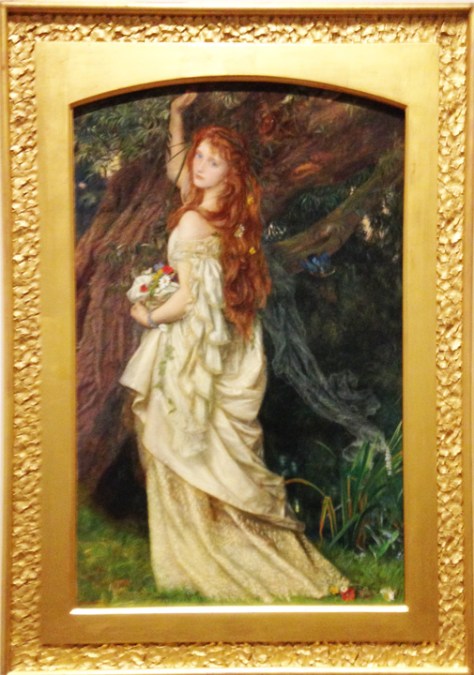
shak3-rev
Ophelia by Arthur Hughes

Few playwrights–fewer than I can count on two  hands–can match William Shakepeare’s  popularity over time. Four hundred years after his death, he is universally revered, frequently performed and freely adapted. The compact  exhibit Shakespeare’s Characters: Playing the Part, on display now through January 8 in Gallery 6 of the Toledo Museum of Art,  celebrates the playwright’s continuing relevance to literature, visual art and theater.

Using paintings, prints and artifacts from the museum’s collection as well as a few pieces from private collectors and from the Blade Rare Book Room of the Toledo-Lucas County Public Library,  Mellon Fellow Christina Larson has curated a fascinating exhibit that traces the path of Shakespeare’s plays through time and taste. She explains:

We saw this [the 400th anniversary] as a great opportunity to honor the Bard with an exhibition.  The focus on Shakespeare’s characters came about after I had looked at Shakespeare-related artwork on view and in storage. This seemed like the unifying  theme and one that would  likely grasp the attention of the public …Overall, the exhibition is about inspiration and influence.  Shakespeare’s characters were greatly influenced by mythology and medieval tales, while his plays  and sonnets have influenced visual artists and musicians”

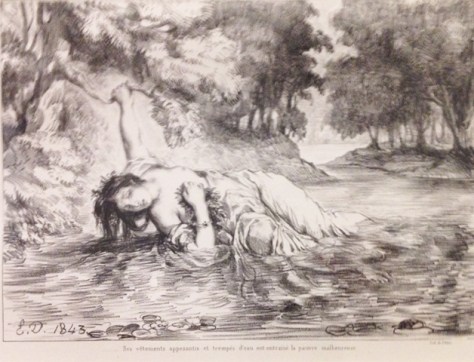
shak4-rev
Ophelia by Eugene Delacroix

Since she was limited in her curatorial choices to works available in the Toledo area, for Playing the Part Larson  has occasionally been forced to draw comparisons between artworks and plays which are not among Shakespeare’s best or most frequently produced. The never popular–and possibly never produced– Troilus and Cressida is represented, rather tangentially, by a beautiful  Greek calyx krater attributed to the Rycroft Painter. But Shakespeare’s popular and frequently performed Hamlet seems to have been a great favorite as a subject among visual artists of the 18th and 19th century and is amply represented here.  Ophelia in particular was a literary figure of great interest,  the pure  female victim being a favorite trope of the time, and is seen  in this exhibit most memorably in Arthur Hughes’s large portrait of the doomed heroine. This lushly painted canvas, the curator’s favorite in the exhibit,  is restrained and  moody and loaded with late Victorian symbolism if you know what to look for.  This is a major work by the pre-Raphaelite artist and one of the most famous in the museum’s collection. Delacroix’s small lithograph of Ophelia, from a series of 13 he created, treats the same subject in a more theatrical vein, and an etching by Eduard Manet of the actor Philibert Rauviere as Hamlet shows that interest in Shakespeare’s plays was not limited to the English.

Because Playing the Part is  a temporary exhibit, the curator was able to include work that, because of its delicacy, age or condition could not be installed in the museum’s more permanently displayed collection.

“Much of the exhibition features prints and photographs. Due to conservation concerns around lighting, this artwork cannot be on permanent view, so an exhibition is the perfect opportunity to feature the artwork for a shorter duration of time,”  Larson says.

Photographs by George Platt Lynes (1907-1955), of actors in a production of A Midsummer’s Night ‘s Dream are a particularly good example of rare artworks on limited view. Lynes, a photographer of the 1930’s and 40’s, was noted for his theatrical and fashion photography as well as male nude photographs now in the collection of the  Kinsey Institute. Another lovely and more contemporary example of rare book art is Ronald King’s unbound, handwritten text with drawings, of Shakespeare’s Anthony and Cleopatra (1979).

shak2
Anthony and Cleopatra, unbound book by Ronald King

Shakespeare’s plays enjoyed renewed popularity across all classes in 18th century Britain as can be seen in the many  volumes reprinting and illustrating his plays in this exhibit.  For both the social elite and the newly prosperous English middle class of the time, the vogue for reprinted editions of his works illustrated their emerging patriotic and egalitarian ideals as the British Empire became a  global power.  The Boydell Shakespeare Folio, 5 engravings from which are represented in this exhibit, was emblematic of the veritable Shakespeare industry that developed during this period.

Of the many delights in this eclectic show, my personal favorite is Iago’s Mirror (2009) by African American artist Fred Wilson. This sinister, opaque-yet-reflective baroque mirror of Murano glass is a (literal) reflection on blackness with all its moral, spiritual and racial implications, and shows that Shakespeare’s timeless story of jealousy, villainy and death in Venice remains resonant for contemporary artists and audiences.


iagos-mirror
Iago’s Mirror by Fred Wilson

Playing the Part establishes without a doubt that William Shakespeare found his genius while rummaging around in the cultural closet of western civilization.  The enduring relevance of Shakespeare’s art comes, not from the conceptual novelty of its premises but from the originality of its execution. He could make a threadbare story feel fresh, the unbelievable seem inevitable, the fanciful seem irresistible. His greatness still resonates with visual artists and has inspired them in turn  to create works of genius.

In addition to the works on display in this exhibit,  Christina Larson and the staff at the Toledo Museum of Art have assembled a packed schedule of related programming, from lectures to film to musical and theatrical performances. And there’s even a Spotify playlist of Shakespeare’s sonnets and music inspired by Shakespeare.   For related museum programs go here

Pulp Covers Culture

multi-cultural-kids-group1Everybody knows that the mainstream print media is in trouble and that as a result, arts coverage in our region has dropped to near zero. But while the rest of us have been whining about the situation, the Ann Arbor Public Library  has done something about it.
Pulp, an online arts and cultural magazine, has started to fill the hole that was left when M-Live and others decided to pull the plug on arts reporting, with articles by some great writers like Patrick Dunn and Jenn McKee.

I just posted my first story on Pulp about the  Pop-X Art Festival and featuring  Ann Arbor Women Artists’ Side-By-Side, a community-based art project that crosses all lines of race, gender, age and disability to promote one-to-one connection. Check it out, and while you’re at it, take a look at some of the other coverage of music, theater and dance.

To investigate Pulp and what it has to offer, go here.

Takeshi Takahara: In Love with the Process


transpiration-5
Transpiration V

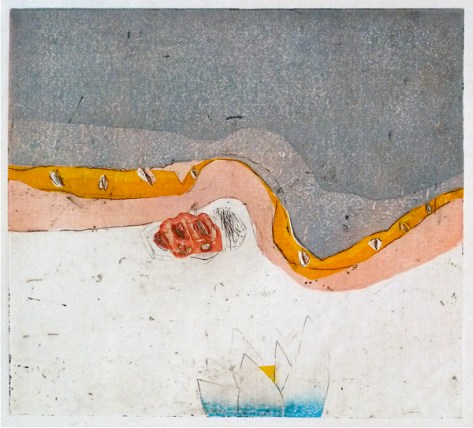
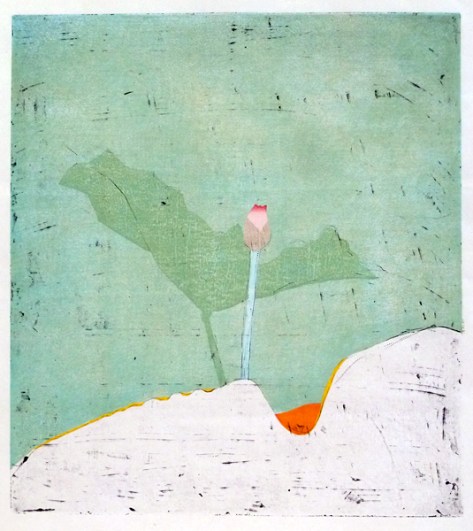
Takeshi Takahara believes in the handmade, the one-of-a-kind, the idiosyncratic. This might seem a counterintuitive attitude in an accomplished master of intaglio printmaking, a medium which embodies the aesthetic of the multiple and reproducible. But in his first solo show at WSG Gallery he demonstrates that his unique, eco-friendly hybrid intaglio/woodcut process for creating small print editions (often only 5 to 9  per title) can deliver artworks that pack all the punch of a one-of-a-kind painting.

Imperfection, a meticulously curated and well arranged grouping  of prints on the theme of the lotus, is on view in the gallery from now until October 22. Images that might seem banal in the hands of a lesser artist–who hasn’t seen a thousand pictures of a lily pond?– gain a kind of archetypal resonance through his drawn line which manages to be both awkward and graceful, with an effortful visual stutter that is reminiscent of the knowing clumsiness of Henri  Matisse or Paul Klee. Through constant experimentation in the studio he has adapted the process of intaglio printmaking, replacing the metal plate and acid  with a less toxic combination of materials while still retaining the sharpness of the cut line. His beautiful-but-not-pretty colors are carefully mixed from watercolor and dry pigments purchased in Japan.

transpiration-2
Transpiration II

Takahara relishes the way in which each print is a document which can be seen through multiple stages on its way to the final version. “In printmaking, you can actually print images step by step and have it. By looking at that proof, you make additions or deletions and move onto another print again and compare those two and see the differences…You get to rethink, revise and remake your original ideas.” He describes himself as uninterested in producing large editions of his prints, preferring instead to experiment with the infinite possibilities of  changing and adapting each plate and combining them in endlessly varied ways.  “Repetition is not my forte,” he says, laughing.

takeshi-out-of-the-mud-xv
Out of the Mud XV

Born in midcentury China to Japanese parents, Takeshi Takahara came to the U.S. to escape his future as the eldest son of a traditional Asian family. He was expected to get a good education and to enter a respectable profession, which fine art certainly wasn’t. “If I’d stayed in Japan, I’d be working in a bank,” he says.

His first stop in the U. S. was  Smith College, where he studied with renowned sculptor and printmaker Leonard Baskin.  Studies at the newly formed school of printmaking at the University of Iowa followed, where he was mentored by Mauricio Lasansky, considered by many to be one of the fathers of modern printmaking.  Although he is now a veteran artist and teacher, this is Takahara’s first experience with an artist-run gallery.

takeshi-out-of-the-mud
Out of the Mud

Takeshi Takahara is currently hard at work creating new prints on the theme of the lotus, which has deep symbolic meaning for him. The lotus rises from the muck and produces a beautiful pure flower, a metaphor for the human condition. “We all come from the same muck, and what we become as human beings is the flower,” he says.

For more information about WSG Gallery’s hours and programs go here


Re: Formation Revisited

re-5-michael-nagara-lo-res
The Garden of Watery Lead by Michael Nagara

The sprawling multimedia, multi-artist show Re: Formation which recently closed in Toledo has moved to a smaller venue in Gallery 117 at the Ann Arbor Art Center where an edited version will be on view from now until October 8.   Toledo’s Re: Formation was overwhelming in size and scope. Installation and video dominated the cavernous former department store,  contributing to an  immersive experience that viscerally conveyed artists’ current outrage over racism, war, environmental degradation and urban decay.

The rage, the politics, the anger at injustice and environmental ruin  remain in this new iteration  but in a lower, more thoughtful key. Smaller work which was somewhat eclipsed by larger and noisier art in Toledo now gets some well deserved attention.

re-6-sharon-que-lo-res
Behind the Clouds by Sharon Que


Moving an exhibit from one very large venue  to another smaller one presents unique challenges for Gallery Project’s curators Rocco DePietro and Gloria Pritschett.

Pritschett explains, “In downsizing the exhibit for Ann Arbor, I look for the core of the work, so that the artist’s essential intent stays intact and can at least be glimpsed… we want to downsize the installation without giving the sense that we just lopped off a part of it.” 

“ It’s a challenge, but a fun challenge,” adds DePietro.

Pritschett continues, “In reassembling the exhibition in a much smaller space, the work is tightly placed, so the specifics of relationships among the works is more crucial. No one piece has a place apart to sprawl on its own as it could in Toledo.   I really enjoy the challenge in the patient work of positioning and repositioning individual works and groups of works, until they cohere visually and conceptually and relate to each other comfortably and meaningfully. For example, the group of Mark Hereld, Endi Poskovic, Tohru Kanayama and Barry Whittaker, and the interactive works Yusuf Lateef, John Anderson and Anthony Fontana, each in some way expresses formation and reformation as a process.  Placing them was really satisfying”

“After spending a month with the exhibit in Toledo, we discovered new relationships among various pieces — themes, shapes, colors, concepts — that we exploited in installing the exhibit.  For example, the interplay of blacks and reds, strong concept works, and the iconic water towers in Flint,” says DePietro.

re-7-boris-rasin-lo-res
Boom Series by Boris Rasin

Pieces with an environmental theme,  such as Jessica Tenbusch’s Veil and  Mark Hereld’s white-on-white Becoming@42Mx are often necessarily scaled to the size of the natural objects they contain, and this new, smaller space allows them to shine. Tenbusch’s work, which  frequently includes taxidermy such as preserved frogs, snakes and the like, can be seen and appreciated for its meticulously detailed and finely produced craftsmanship.

re-1-hereld-lo-res
Becoming @ 42Mx by Mark Hereld

Paintings  which were a bit overwhelmed in the large, dim Toledo space come into their own here. John and Sandy: Voices for Social Justice, a large painted allegory (notice the small winged figure of Governor Rick Snyder in the upper left hand corner) by Ken Milito is impressive, and Michael Nagara’s Garden of Watery Lead  seems at home in this smaller scale and more brightly lit gallery.

Equally successful in both Toledo and Ann Arbor is John James Anderson’s photo series 189 Hydrants, which documents, hydrant by hydrant, Washington D.C.’s  decaying infrastructure. His Omikuji also stands up well to the move.  Based on a Japanese cultural custom meant to end  a curse, gallery visitors are encouraged to participate in a ceremonial exorcism  to end police killings.

“In the wake of the recent deaths of Philando Castile and Alton Sterling,  I took a moment to consider the thousands of other lives lost in recent years during an encounter with the police,” says Anderson.

He adds, “While the circumstances behind each are different, in sum, it is as though there was a great curse within our culture that causes these issues to persist.

In this improvised and sobering ritual, the name of a young man of color who has died at the hands of the police is printed on a strip of paper along with the Kanji for “end curse” and tied to the wooden structure in the gallery.

re-3-installation
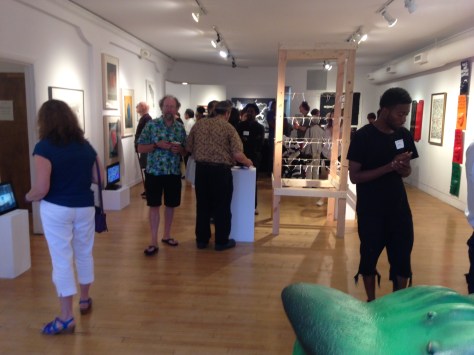
Opening reception at Gallery 117, Ann Arbor ArtCenter, with Omikuji by John Jacob Anderson’s Omikuji at center right.


re-8-yusef-lateef-lo-res
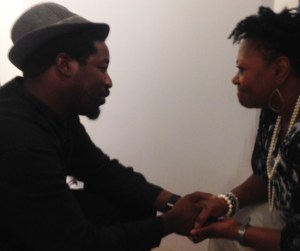
Yusuf Lateef in an encounter with Saganaw photographer Mary E. Foster

The single most memorable work in Re:Formation remains The Reconditioning, an experiential performance and personal encounter designed and executed by Toledo artist Yusuf Lateef in collaboration with Chris Rogers,  Kevin Gilmore, Daren Mac and James Dickerson.  Lateef was initially apprehensive about reproducing The Reconditioning for an Ann Arbor audience after a previous cathartic experience with audiences at Re:Formation in Toledo.  He was afraid he would be “reproducing this thing that wasn’t a personal and individual experience.”  The placement of the installation at the entrance of the exhibit made him feel as if he and his fellow performers were in danger of becoming objects in an art show.  But The Reconditioning, once again, found an audience of eager participants willing to engage the artists/performers on the subject of race and connection.  Lateef, encouraged by recent experience, plans to refine and simplify these encounters in the future.

“It took time to get out of my own way,” he says.

For more information about Ann Arbor Art Center go here

Artists exhibiting in Re:Formation are: Heather Accurso, Hiba Ali, John James Anderson, Michael Arrigo, Siobhan Arnold, Nick Azzaro, Darryl Baird, Barchael (Barry Whittaker and Mike Bernhardt), Morgan Barrie, Carolyn Barritt, Beehive Design Collective (Meg Lemieur), Mark Bleshenski, Jada Bowden, Seder Burns, Ruth Crowe, Dana DePew, Rocco DePietro, Desiree Duell, Dianne Farris, Susan Fecteau, Anthony Fontana, Mark Hereld, Dan Hernandez, Stephanie Howells, Tim Ide, Doug Kampfer, Tohru Kanayama, Yusuf Lateef, K.A. Letts, Kate Levy, Julianne Lindsey, Jeremy Link, Melanie Manos, Shanna Merola, Ken Milito, Michael Nagara, Jefferson Nelson, Endi Poskovic, Gloria Pritschet, Sharon Que, Raizup Collective (Antonio Cosme), Boris Rasin, Roger Rayle, Jesse Richard, Arturo Rodriguez, Gary Setzer, Meagan Shein, Anna Schaap, Sheida Soleimani, Brian Spolans, Jessica Tenbusch, Alex Tsocanos, Ellen Wilt, Robin Wilt, and Viktor Witkowski.


For Forage: 4th Annual Festival of the Honeybee Art Exhibition

bee-ann-katrine-2
Apis Mellifera x Homo Sapiens: Symbiotic Colony

As summer draws to a close and harvest time approaches, Jessica Tenbusch, Elize Jekabson  and Maggie Spencer  invite us to consider the honeybee.

The exhibit For Forage celebrates, in collaboration with the 4th Annual Ypsilanti Festival of the Honeybee, the many ways in which this indispensable insect contributes to the natural environment and human well-being. Participating artists were invited to “share visions, critique relations between humans and honeybees, share new perspectives.”  And share they have, with a variety of intriguing and insightful artworks that are well worth a trip to 22 North Gallery, in Ypsilanti MI,  where the exhibit will be on view until September 30.

bee-Riva-1
Colony (detail) by Riva Jewell-Vitale

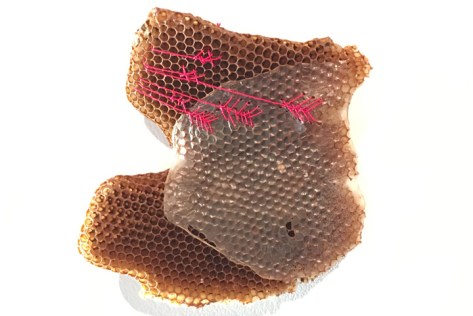
In the cooperative, hardworking and self-effacing spirit of the honeybee, the anonymous collective Ann Katrine has created a series of small, wall-mounted artworks that combine the production of insect, bacteria, yeast and humans in a creative relationship.  The bees provide the honeycomb and the artists riff on the hexagonal shapes with red embroidery thread, sometimes echoing, sometimes augmenting the shapes. The translucent coating visible on the surface of the works is dried kombucha, a microbial cellulose material which is derived from symbiotic colonies of bacteria and yeast (SCOBY). These subtly glowing objects  echo the interconnectedness of nature from the microscopic to the insect to the human.

bee-lush-lapel
Pursuit of Pollen by Lush Lapel

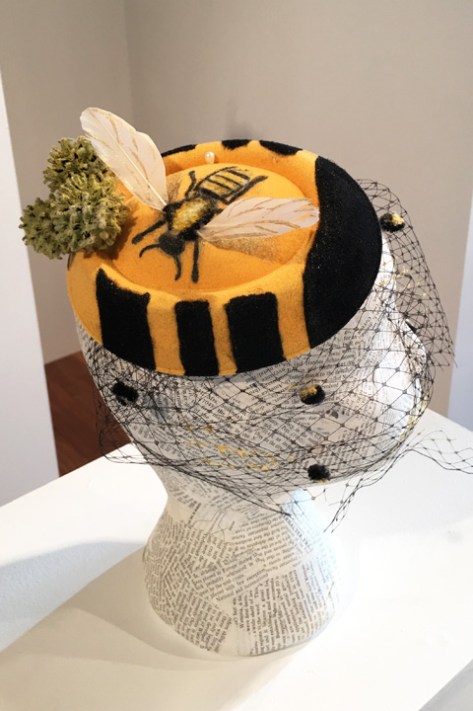
A more playful tone is set by  two fashionable and off-beat hats created by Lush Lapel. In Pursuit of Pollen, the honeybee  appears as a decorative motif, along with seed pods, feathers and other bits and pieces. The results are fit for a queen bee of any species.

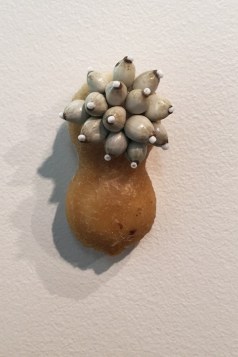
Also seriously fashionable are the brooches, necklaces and rings created by Riva Jewell-Vitale.  Her multi-piece wall-mounted installation of jewelry, entitled Colony, demonstrates her considerable talent as a collagist. She  creates inventive combinations of unexpected components that somehow result in elegant and mysterious wearable sculptures. bee-ryan-bogan

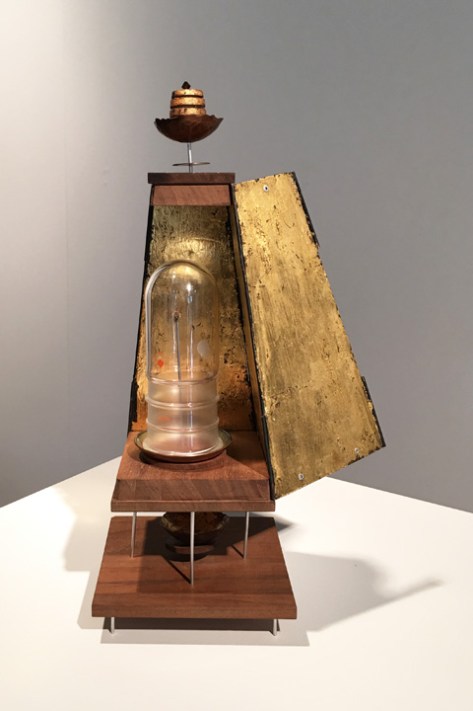
A more reverential note on the honeybee as Nature’s  martyr and saint is struck by Ryan Bogan. His insect reliquary, Blessed is the Fruit of Thy Womb, features the tiny body of  a honeybee suspended in a glass dome surrounded by precious gold leaf. Lovingly crafted and carefully composed, this piece wouldn’t be out of place in a modern religious setting.

If you are planning a trip to Ypsi to see For Forage, remember that 22 North, like many other arts spaces in the Detroit metro area, is open during limited hours during weekdays and on weekends, or by appointment. To find out more about the gallery’s exhibits and events go  here.

Or call:  501.454.6513

Artists in For Forage: Meagan Shein, Brad Naftzger, Heather Leigh, Ann Katrine Collective, Owen Wittekindt, Marshelia Williams, Michael O’Dell Jr., Rive Jewell-Vitale, Jonathan J. Sandberg with Kevin Kwiatkowski, Ryan Bogan, Lush Lapel