Valerie Mann, Safety Net, 2021, reclaimed fabric and wire, thread, steel, 39″ x 44″
I’ve been a fan of Valerie Mann’s work for years. She is a master at re-imagining the formal potential of discarded and un-loved materials , transforming them into new and emotionally resonant objects and images. I wrote about her recent exhibition “Good Grief” at the Birmingham Bloomfield Art Center for Detroit Art Review. You can read my thoughts on her work here . That show closed on June 1st but now you have a chance to see it re-installed at 22 North Gallery in Ypsilanti . 22 North routinely showcases outstanding art by artists working in Southeast Michigan, but their hours are variable, so call before you go!
Congratulations to multi-disciplinary Iranian-born artist Parisa Ghaderi for winning the annual 2023 Envision: Michigan Artist Initiative Award! The jurors, Neil A. Barclay of the Charles Wright Museum of Art, Shannon Rae Stratton of Ox-Bow School of the arts and Nayda Collazo-Llorens, last year’s winner, had their work cut out for them. The other finalists for the prize were BakPak Durden and Levon Kafafian. To read my review of the exhibition of works by the finalists at the Penny Stamps Gallery in Ann Arbor, you can go to newartexaminer.org
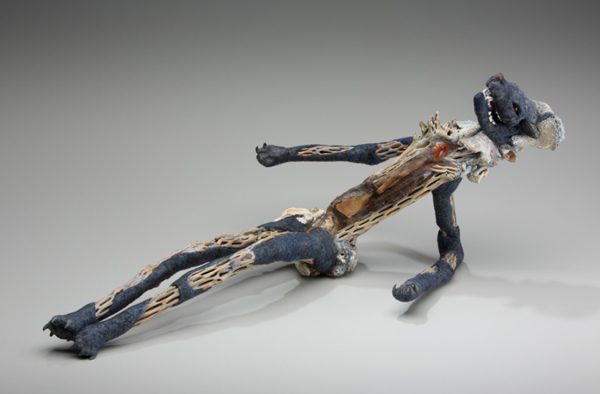
Guide, cholla cactus, shells, handmade felt, petrified wood, animal skull, agate and banded iron. 12″ x 29″ x 14″
Attractive and repellant, humorous, tragic and tortured, the otherworldly figures created by visionary artist Susan Aaron-Taylor live on the shadowy boundaries between what we know and what we imagine. In her solo exhibition Strata, now on view in the Connections Gallery of the University of Michigan’s North Campus Research Center, the artist pulls 14 individual figures from her unconscious mind and presents them to us, hoping to awaken the sense of a shared, but often unseen, emotional and spiritual reality.
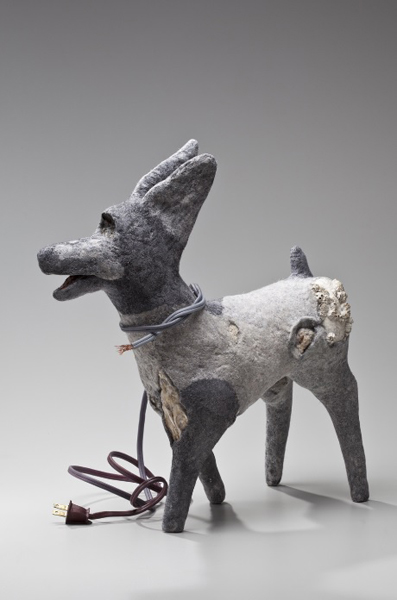
Unplugged, handmade felt, shells, electrical plug, 17″ x 18″ x 10″
Made of felt and found objects, the sculptures in this exhibition blend alchemy, dreams, rituals, mythology, and shamanism with the detritus of matter to create a persuasive but disquieting world suggestive of malevolent fairy tales or ambiguous dreams. Aaron-Taylor claims to appropriate the power of what she calls the “shadow side”, a term of Jungian psychology referring to a “composite of personal characteristics and potentialities that have been repressed and underdeveloped in our conscious lives.” Her creatures are fetishistic archetypes, stand-ins for the unconscious, and spirit guides to unexplored psychological regions. In their combination of fabric wrapping over found natural armatures and amulet-like appliques, they strongly resemble the mummified animals of ancient Egyptian tombs.
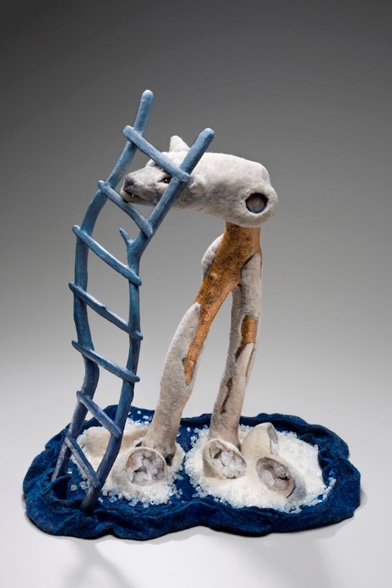
The figures often seem to be in pain. In Polar Bear, the armless animal snarls as it tries usuccessfully to free its head from the rungs of a ladder. WinterRat‘s paws are extended upward, as if to escape the implied danger of the surrounding pool. The eyes of the creatures are often hazed, and bones, claws and teeth protrude.
Polar Bear, wood, handmade felt, geodes, porcupine quills, cabochon and beads, 19″ x 17″ x 13″
Aaron-Taylor describes her art practice: “My intense exploration of mediums and techniques over the year’s gives me the freedom to incorporate a wide range of materials. Found wood, fleece, minerals, cactus, porcupine quills, beads, shells, bones, and kozo fiber have all been appropriated. Blending the accumulated strata creates autobiographical narratives where rhythm, balance, and harmony invite the viewer’s participation. My intention is to connect the spiritual and the physical worlds.”
One might wonder at the selection of this artist’s work for a venue that is devoted to science and the pursuit of the quantifiable, but bringing provocative and thoughtful art to the NCRC’s campus is part of the gallery’s mission as described by NCRC Art Coordinator Grace Serra. “What I want to happen here is … not just a nice enhancement of quality of life [or to] offer an environment that is stimulating,” she says “…but maybe some of these shows can be the catalyst for thinking differently about the problems [researchers and scientists] are solving in their labs.” She envisions additional events relevant to the NCRC exhibition schedule and says, “I’d like a little more programming around the exhibits, so maybe we can get people thinking about what’s going on here and how it can relate [to their research].” She points out that linking the arts with the sciences is very much part of the University of Michigan’s mission. She adds, “It can help people to become global thinkers.”
Strata, located in Connections Gallery on the lower level of Building 18 of the North Campus Research Center, 2800 Plymouth Road, Ann Arbor, will be open to visitors until December 12, 2017. The gallery is open Monday-Friday, 9 a.m. – 5 p.m. For more information about the NCRC Art Program go here
I just completed a review of Detroit artist/gallerist Adnan Charara’s terrific new show at North Campus Research Center’s Rotunda Gallery in Ann Arbor. To read the full review in AADL Pulp, go here
It’s a challenge to write about the current exhibit Art Now: Printmaking, installed in Gallery 117 of the Ann Arbor Art Center, not because there is so little to say but because there is so much. Art Now is the third in a series of large group shows of artworks sorted by media. No less ambitious than the first two (devoted to painting and photography), Art Now: Printmaking shows us how fine art printing in all its variety stands at the busy crossroads of traditional media and advancing technology.
Juror Tyanna Buie, an accomplished printmaker in her own right, has selected artworks by 86 artists from all over the country that describe the ways in which the methods of printmaking can be stretched to their outer limits and combined with other techniques such as collage, painting, drawing and photography, to name only a few.
Mud Philosophy by H. Schenck
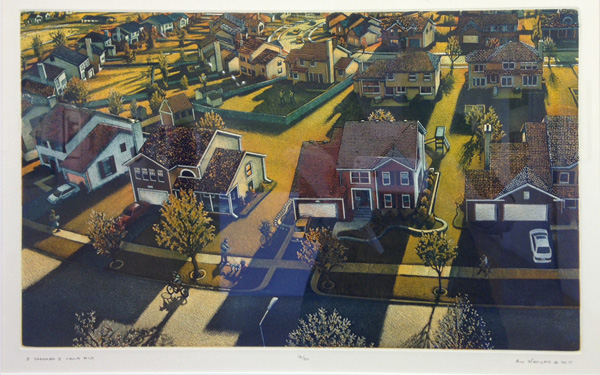
Traditional printmaking is a craft as well as an art. The process is exacting and rewards methodical attention to draftsmanship, registration, consistency– and there is no shortage here of artists well qualified to work within the constraints of the media. I especially liked many of these traditionally produced prints –silkscreens, woodcuts etchings and the like– because the artists have found freedom of expression within the limitations of their means. A particular favorite is the dreamlike suburban landscape I Dreamed I Could Fly, an etching/aquatint by Art Werger, where the warm, low light of the late afternoon sun washes over a scene of perfect order, the world held in stasis for an eternal moment. Hunter’s Moon Dancer by North Dakota artist Linda Whitney, a finely observed and expertly drawn mezzotint (and winner of Second Prize) is deeply satisfying in its symmetry and rhythmic patterning. Winning my own personal and unofficial prize for staying on topic is a pair of deeply saturated green and gilt silk screen prints, Gold Nah Dar Gold by Chad Andrews, in which the image and the process are synonymous.
Hunter’s Moon Dancer by
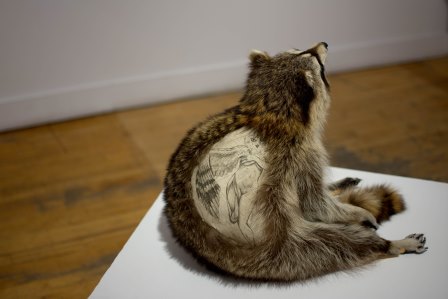
Although there are many excellent examples of well conceived and well executed printmaking here, a visitor’s attention is inevitably drawn to artworks that surprise us with their idiosyncratic juxtaposition of media. It is entirely unexpected that taxidermy would figure in a print show, but there it is in Ashley Shaul’s But She Looked Friendly, which features a furry raccoon with a meticulously rendered tattoo on her backside.
But She Looked Friendly by Ashley Shaul
Combining different types of printing, painting, collage and photography seems to be a favorite strategy for many of the artists represented in Art Now: Printmaking. These works are technically monotypes and utilize the syntax of various print media in combination to arrive at artworks which go far beyond the technical simplicity of the traditional monoprint.
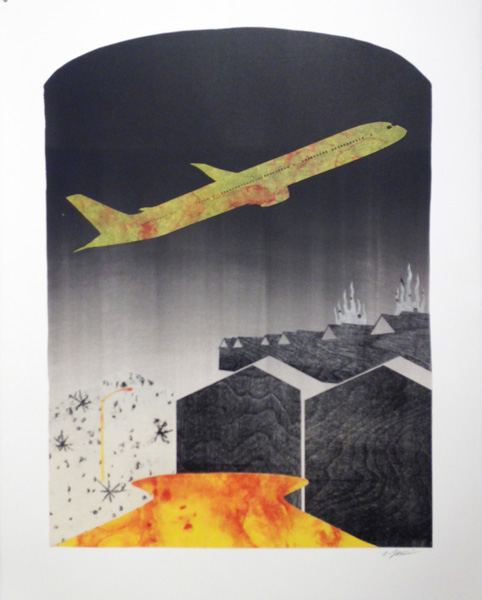
Cul-de-Sac by Zack Fitchner
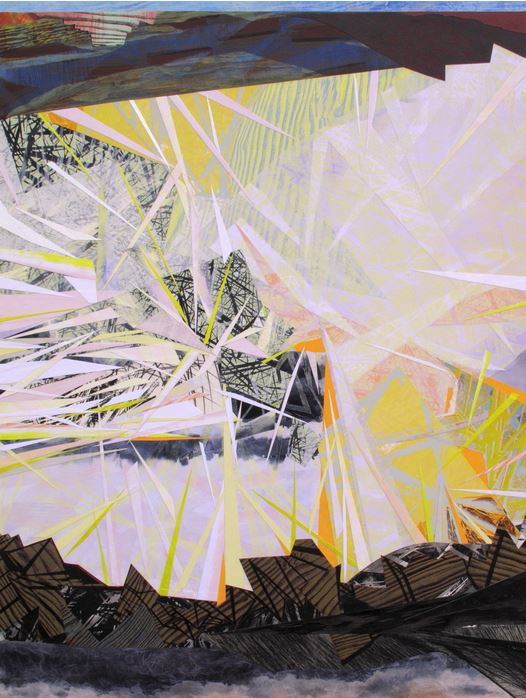
One of my favorite one-of-a-kind prints, Mud Philosophy by H. Schenck of Grand Prairie TX, makes the most economic statement possible, using Washington mud marked on glass and run through a press. Another multi-technique monotype success is Cul-de-Sac by Zack Fitchner of Charleston, West Virginia. He uses lithography, woodcut, monotype and chine colle to evoke the overhead racket of planes taking off from an urban airport. The artwork that won Best in Show is one of these everything-and-the-kitchen-sink type multimedia extravaganzas too. Ebb and Flow, by Carolyn Swift of Traverse City MI, combines woodcut, relief, etching, acrylic paint, ink and colored pencil in a large, energetic abstraction that practically jumps off the wall.
Ebb and Flow by Carolyn Swift
A show with this much material in it can’t be adequately described in print. Art Now Printmaking requires your attention –and attendance. As a nice bonus, if you have an interest in collecting relatively inexpensive works on paper, you really should take in this exhibit. Even works that are clearly one-offs are a bargain here. The exhibit is open until March 4. For more information go here
Vertical Vision by Tim Gralewski
Crown House by Tom Baker
The Golden Cage by Genie Gao
Art Now: Printmaking is on view until March 4. Featured Artists are: Chad Andrews • Miguel Aragon • Robert Aronson • Tom Baker • Naomi Ballard • Jennifer Belair • Karen Benson • Shirley Bernstein • Laura Beyer • Benjamin Bigelow • Allison Blair • Ben Bohnsack • Jan Brown • Josh Christensen • John Cizmar • Abraham Cone • Schuyler DeMarinis • Tess Doyle • Andrea Eckert • Stacy Elko • Travis Erxleben • Craig Fisher • Frank James Fisher • Zach Fitchner • Cindi Ford • Arron Foster • Jenie Gao • Eric Goldberg • Helen Gotlib • Tim Gralewski • M. Alexander Gray • Brett Grunig • Tatsuki Hakoyama • Dominica Harrison • Tom Hollenback • Richard Hricko • Joyce Jewell • Rhonda Khalifeh • Tonia Klein • Joshua Kolbow • Alexis Kurtzman • Emily Legleitner • Geneviève L’ Heureux • Alexandria McAughey • Tyreese McDurmont • Dante Migone-Ojeda • Zachary Miller • John Miller • Eric Millikin • Ashley Nason • Nick Osetek • Carole Pawloski • Polly Perkins • Liv Perucca • Sylvia Pixley • Tatiana Potts • Linda Prentiss • Morgan Price • Laurie Pruitt • Christine Reising • Karen Riley • Benjamin Rinehart • Celeste Roe • Mary Rousseaux • R Ruth • Blake Sanders • H Schenck • Melissa Schulenberg • Terry Schupbach-gordon • Kayla Seedig • Sarah Serio • Ashley Shaul • Sarah Smelser • Barbara Smith • Jillian Sokso • LaNia Sproles • Emily Stokes • Lonora Swanson-Flores • Carolyn Swift • Olivia Timmons • Donald VanAuken • Roger Walkup • Annie Wassmann • Ian Welch • Art Werger • Linda Whitney • Maryanna Williams • DeWayne Williamson • Connie Wolfe • Mary Woodworth • Cameron York
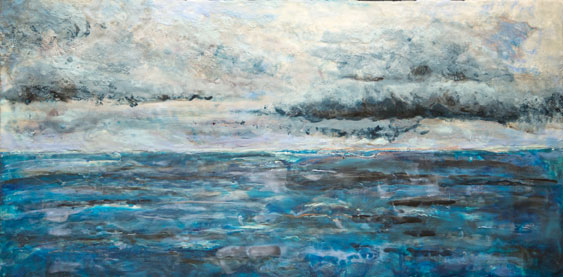
Lake Michigan Deep Blues by Leslie Sobel at WSG Gallery
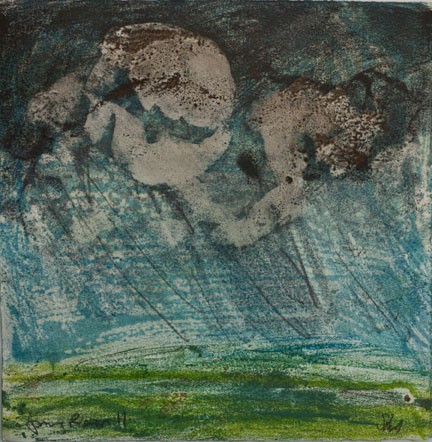
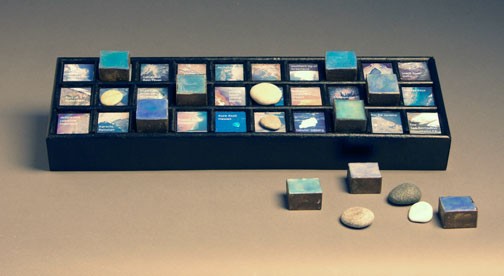
Artist Leslie Sobel both loves nature and fears for it. An avid hiker and outdoorswoman, Sobel’s encaustic paintings, monoprints and three dimensional assemblage celebrate the mystery and majesty of nature while describing the effects of human-caused climate change. They are often based on personal observation of the landscape but can also be inspired by online aerial images of glaciers or maps of open territory at the poles. One of Sobel’s great ambitions is to see the lands of the far north and Antarctica before they are forever changed by global warming. “I am affected by solastalgia,” she says. Sobel describes solastalgia as “nostalgia for a place one has never been and that is no longer there.”
Spring Rain II
Three of Leslie Sobel’s encaustic paintings are on view now in Ann Arbor at WSG Gallery, as part of their 16+16 members invitational show, on view until February 4. All 3 works in the exhibit relate to a single transcendent moment Sobel experienced while hiking at the crest of the Sleeping Bear Dunes. She and her companion were alone, a rare occurrence. As she looked out over the brooding seascape of Lake Michigan and the clouds rolling above, Sobel had a profound sense of the small and temporary nature of human existence in the face of nature. These somber thoughts inspired the creation of several encaustic paintings which feature only the stormy sky and Lake Michigan, separated by a distant horizon.
Row of Pines by Leslie Sobel
In addition to these private meditations, Sobel does public commissioned artworks, most recently her downtown PowerArt Box. Based on her painting “Row of Pines”, it is one of several selected by online popular vote through Ann Arbor Arts Alliance’s PowerArt Project. The aim of the program is to install reproductions of works by Washtenaw County artists on power boxes throughout the city in order to add visual interest to the streetscape and to discourage tagging on utility boxes. Phases 1 and 2 have been completed and now Phase 3 is in the planning stages. The Arts Alliance is actively soliciting sponsors for individual power boxes. For more information go here.
Sobel’s interest in the natural environment has also led to her participation in numerous artist-in-residence programs in national parks, where she is often paired with scientists and naturalists working there. She recounts with special pleasure a recent residency in Colorado’s Canyon of the Nations National Monument, where she worked alongside archeologists, biologists, anthropologists and geologists. “I was surprise how much these ruins tied in with my interest in climate change–the people who lived here didn’t die. They had to move because they had depleted and degraded the local natural resources. When archeologists searched the middens (trash heaps) of the abandoned settlements, they found that earlier ones held the remains of deer and antelope, while the later ones had the bones of chipmunks and mice.” In the later middens. they also encountered human remains showing signs of cannibalism, a grim reminder of true scarcity that led to their departure for points further to the southwest where it is believed they became the Hopi nation.
Climate Change Game
In at least a partial fulfillment of her dream to see the far north and south latitudes before they are changed forever, Sobel is planning an extended visit to the Yukon in 2017. She will camp and create in Kluane National Park at the invitation of scientist and researcher Seth Campbell of the University of Maine. Like so many worthy projects, this is an unfunded labor of love; Sobel will be soliciting funds for the trip soon in a GoFundMe campaign. For more information about Leslie Sobel, go here.
I recently posted a profile of street artist David Zinn in Pulp magazine. Zinn is a master of the ephemeral and has a unique take on art, who makes it, who can make it and to what purpose. Check it out here.
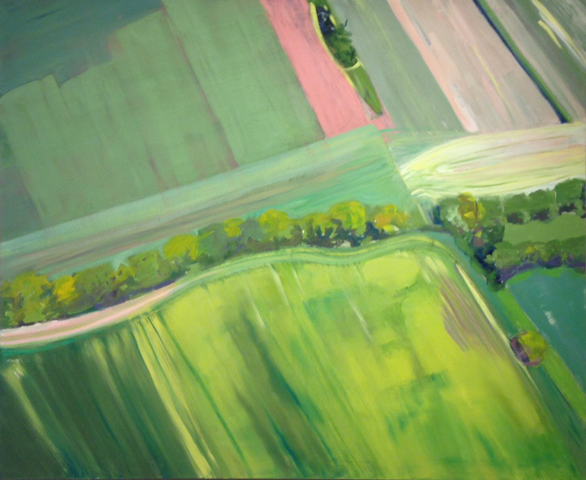
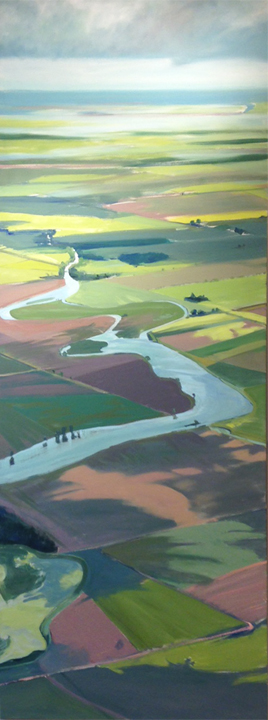
From Above, a small collection of paintings on view until November 26 at WSG Gallery in Ann Arbor, shows Karin Wagner Coron continuing her ongoing exploration of the Midwestern landscape. Working with photos taken from an airplane, this accomplished contemporary artist has created a select group of views of Midwestern fields and vistas punctuated and bounded by the fresh water lakes and rivers of the region.
These birds-eye views emphasize the agricultural geometry of Michigan and Ontario fields, delivering the illusion of flying over the limitless sweep of land that is the Midwest.
Thames River, Ontario, Canada
Many of the landscapes feature a kind of vertiginous diagonal composition, as if she is looking from the window of a steeply banking airplane (which in fact she is). She describes her process:
“I use photography as a basis for my compositions, to capture a particular time of day, interesting light or composition. I perceive and interpret nature while constantly finding a new palette or color scheme to match mood and feeling.”
Landscape paintings from an aerial point-of-view are nothing new, of course. Chinese painters from the Tang Dynasty onward painted nature as if from a neighboring mountaintop, each landscape a transcendent retreat from the banal and everyday. And painters of the Hudson River School such as Thomas Cole and Frederic Edwin Church painted landscapes from overlooks that emphasized the limitless grandeur of the newly discovered American West.
In contrast to the escapist romanticism of Chinese landscape painters and the romantic imperialism of American painters of the West, Coron’s aerial landscapes revel in the orderly section and bisection of the land, with farmers’ fields cut by dirt roads and softened at the edges by hedgerows. This overhead perspective is especially appropriate for topography that is essentially flat. Pattern and color measure the paintings’ depth with the slightly diagonal compositions of many of the artworks leading us into the painted distance.
Coron’s vision of nature only lightly ordered by humans contrasts with that of other noted contemporary landscape artists such as Yvonne Jacquette and Rackstraw Downes, who emphasize the built environment over natural features and imply human habitation and activity. Coron, being a Great Lakes artist, also gives equal weight to the meandering of rivers and the inchoate shadows of clouds passing overhead even as she accepts the tamed land below her.
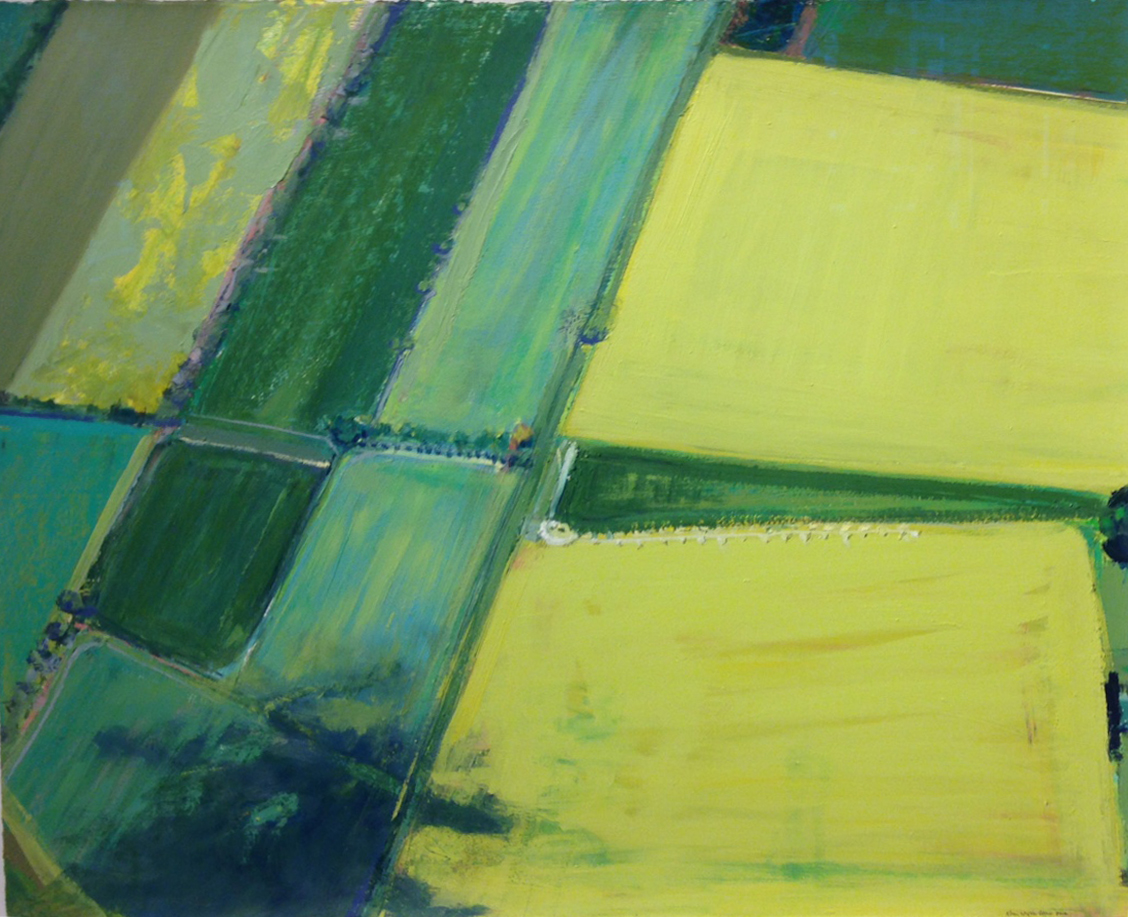
In the end, although these paintings clearly reference the Midwestern landscape they can also be appreciated for their more formal qualities. The color palette she has chosen for this series, with its acid yellows, juicy greens, muted pinks and aquatic blues, is more expressive than descriptive. Coron invites us not only to enjoy these paintings as descriptions of regional topography and atmosphere, but also to appreciate their sophisticated abstract sensibility.
Yellow Green Fields #1
Karin Wagner Coron has been exhibiting her paintings and prints professionally since 1992. A graduate of Eastern Michigan University with a BFA in painting, she is owner and manager of Format Framing and Gallery in Ann Arbor, and is a member of WSG Gallery, also in Ann Arbor.
For more information about WSG Gallery and this exhibit, go here.
The winners of prizes for Ann Arbor Art Center’s 94th All Media art exhibit Free Wet Hugz which opened October 14 have been announced. They are:
Jean-Paul Aboudib (Chaos In Captivity), Louis Boyang (Mother’s Day), CJ Breil (Conduct Becoming: Surveys #3 and #4), Yuling Chuang (Exist, Coexist: Harmony 2), Analicia Honkanen (Dallying (Free Wet Hugz), Nathan Margoni (No Fear), Robert Mirek (No. 681), Julia Pangborn-Harley (A Brown, Gravelly Road Framed by Barren Plants), Cristin Velliky (Hull), Yuge Zhou (Green Play)
The award winners were chosen by Juror Paul Kotula, who has worked as a gallery director for Pewabic Pottery, Swidler Gallery, REVOLUTION (Detroit and New York) and paulktoulaprojects. Working with an international list of artists, he has formed over 200 solo and group exhibitions pertinent to the field of contemporary art and visual culture.
For my review of the show in Pulp Magazine go here.
Everybody knows that the mainstream print media is in trouble and that as a result, arts coverage in our region has dropped to near zero. But while the rest of us have been whining about the situation, the Ann Arbor Public Library has done something about it.
Pulp, an online arts and cultural magazine, has started to fill the hole that was left when M-Live and others decided to pull the plug on arts reporting, with articles by some great writers like Patrick Dunn and Jenn McKee.
I just posted my first story on Pulp about the Pop-X Art Festival and featuring Ann Arbor Women Artists’ Side-By-Side, a community-based art project that crosses all lines of race, gender, age and disability to promote one-to-one connection. Check it out, and while you’re at it, take a look at some of the other coverage of music, theater and dance.
To investigate Pulp and what it has to offer, go here.



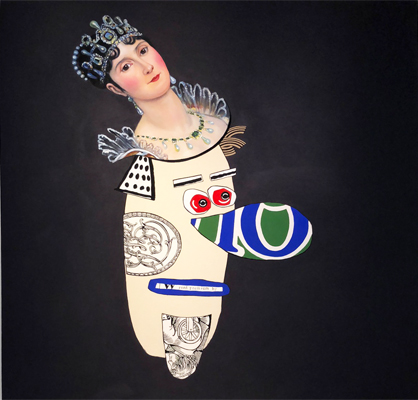





 The winners of prizes for Ann Arbor Art Center’s 94th All Media art exhibit Free Wet Hugz which opened October 14 have been announced. They are:
 Everybody knows that the mainstream print media is in trouble and that as a result, arts coverage in our region has dropped to near zero. But while the rest of us have been whining about the situation, the Ann Arbor Public Library has done something about it.
 Rustbelt Arts