Space Between Time

Newly arrived from the suburbs, Wasserman Projects art gallery is what I hope the future art spaces of Detroit will look like-clean, well lit, and elegant (and open more than once a week for 3 hours!) The museum-quality treatment that Esther Shevel-Gerz’s  Space Between Time receives from the gallery  convinced me that I needed to look more carefully at her work than I would otherwise be inclined to, since I’m not a great fan of conceptual art generally.

Esther Shevel-Gerz  employs a visual idiom that I would call high academic. She combines video, art photography and text to convey her recurring themes: the fugitive nature of memory, the inexorable passage of time and inevitable loss. Although they are a little forbidding at first approach, her art works are actually fairly straightforward   (with one exception which I will get to later). They are a kind of institutional art, each one having been installed originally for a  specific  museum, school or cultural institution. Shelev-Gertz’s works are related very closely to the sites for which they are conceived and often incorporate the people who work at or attend  that institution.  You, as the viewer, are called upon to imagine them installed in that setting in order to appreciate them fully.

Esther Shevel-GerzThe  most accessible and appealing work, to my mind, was created for the Municipal Library of Vancouver and is entitled The Open Page. It is a suite of high resolution, large-format photos of antique rare books selected by the librarians from the locked stacks of their library.  Each one is  tenderly held in the disembodied hands of its keeper. The reverent love of the librarians for these beautiful objects is palpable.

The most conceptually  challenging work,  Inseparable Angels, is a quasi-installation. A video with audio, two black and white photographs, two color photos, a clock that runs both forward and back,  and  accompanying text are displayed along a back wall of the gallery.  All of this was  originally installed in the upper story of a house at the Bauhaus University in Weimar. In Inseparable Angels Shevel-Gerz imagines a home for Walter Benjamin, a prominent philosopher who committed suicide in 1940 while fleeing the Nazis. The video records a 15 minute  trip from Weimar to Auschwitz. The taxi driver recounts various “sights” along the way,  all of which appear only in his memory, as they no longer exist in fact.  The 2 adjacent color photos represent  sites where now-absent places once stood.
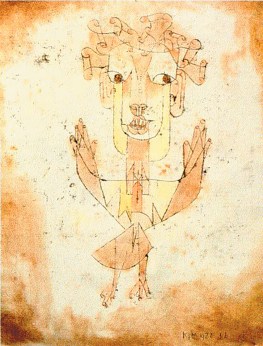
Paul Klee: <i>Angelus Novus</i>, 1920
Paul Klee: Angelus Novus, 1920

The accompanying text refers to his journal, Angelus Novus.  This was also the title of a Paul Klee painting of the same name (which Benjamin owned). In spite of its sweet appearance, this angel was far from benign. For Benjamin this was the angel of history:

 “His face is turned toward the past. Where we perceive a chain of events, he sees one single catastrophe which keeps piling wreckage upon wreckage and hurls it in front of his feet. The angel would like to stay, awaken the dead, and make whole what has been smashed. But a storm is blowing from Paradise; it has got caught in his wings with such violence that the angel can no longer close them. The storm irresistibly propels him into the future to which his back is turned, while the pile of debris before him grows skyward. This storm is what we call progress.”

The work that may resonate most with a Detroit audience though,  is Describing Labor, created for the Wolfsonian Museum in Miami Beach, Florida. A split screen video shows interviews with the museum personnel, each of whom has chosen an artwork that shows people engaging in manual labor.  The interviews create a peculiar kind of double vision; mind workers talking about manual workers as if they are anthropologists talking about a concept of labor that exists now only as a kind of historical artifact. In a nearby vitrine, the point is driven home even more clearly. Hammers have been cast into clear glass, useful tools no longer having a use.

In the end, to my surprise, I found I liked Esther Shevel-Gerz quite a lot.  Her cool, conceptual approach allowed me to thoughtfully contemplate themes that are always in the back of the mind but rarely get our full attention.  Her work is also a reminder of the importance of institutions such as museums and libraries.  They are repositories of our collective memory that allow  us to recall what we might otherwise forget. And she introduced me to Walter Benjamin, who I am coming to know better as I read his essay The Work of  Art in the Age of its Technological Reproducibility (more of a page turner than you might think from the title.)  So…thank you Wasserman Projects!

Space Between Time is on view until July 9.  The gallery, located at 3434 Russell Street, is open Wednesday-Saturday. Parking is available on site. For more information go to http://wassermanprojects.com/
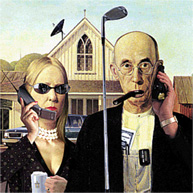
 

Call for Entry: Real American

Ann Arbor Art Center is seeking work for Real American, a juried exhibition to be held in 117 Gallery at the Art Center from July 1 through August 17, 2016. The deadline for entry is June 12, 2016.  The juror is Peter Baker, an Ann Arbor photographer whose work has appeared in The Wall Street Journal, Bloomberg Businessweek, ESPN The Magazine, National Geographic Traveler. All art media are welcome.

Entry fee is $35.00

Entry Deadline: 6/12/16

What is “Real American”? We seek to explore then generational, ethnographic, cultural, and anthropological ideals of what the word American means. From fresh apple pie to Budweiser, the Star Spangled Banner to Party in the USA, what is the modern American experience? Are we entering the sci-fi World of Tomorrow, longing for the Norman Rockwell past, or painting ourselves into an Idiocracy? If our culture is our biggest export, what kind of image are we presenting to the world? This exhibition seeks artworks that span the spectrum from whimsical to austere, nostalgic to provocative. Artworks may consist of images from popular and visual culture, contain everyday objects assembled in unexpected ways, or incorporate stars and stripes.real american

Awards:
$500 Best In Show
$200 2nd Place
$100 3rd Place
Two Honorable Mentions

Artists are invited to submit up to three images as jpeg files per entry. Artworks should have been created within the past three years and not previously shown in any Ann Arbor Art Center exhibitions. All media are welcome.

For more information go here:

Did you Blink?

… If you did, you missed it.  I didn’t think it was possible for the hours at Whitdel Arts to get shorter. But I was wrong. Whitdel Arts, like many volunteer-run art spaces in Detroit, keeps its doors open only on 1 day a week for 3 hours per month-long show, a total of 12 hours. I have often struggled to get to Whitdel’s  well-conceived and well-installed shows during that window. But the  most recent show, One Year Later: Work by Tisch Mikhail Lewis was open only for 5 hours total, on Friday, May 13 and Saturday, May 14. This pop-up exhibit was held in a recently renovated and still empty craftsman-style  house on Commonwealth Street in Detroit. More about that later.

The stated theme of  One Year Later is our societal obsession with body image, weight control and conventional ideas of beauty.  Lewis says, “I use my work as a way to make sense of the world around me by deconstructing my experiences and examining them in terms of sociological theory pertaining to identity, body image, race and intersections between the three.”

These predominantly blue and yellow figures, mostly painted on raw canvas, didn’t strike me as being hard-edged political statements though.  Instead I found them to be lyrical and virtuosic figure studies, deftly done, and  quite pretty. The paintings are   relatively small scale, which gives them an air of intimacy that I enjoyed even though it undercuts somewhat the stated theme of the show.  It’s fashionable these days to make a political point with one’s art, but it seems to me that lovingly created and well drawn traditional figures  have value too.

whitdel 2

Now, as to why Whitdel Arts is open during shortened hours in a pop-up gallery. I have some bad news:

Through no fault of their own, the collective recently found itself out on the street following a sudden  notification from their landlord that their presence in the space was no longer welcome. While I  understand that nothing lasts forever, and that a landlord who has been generous in the past is under no obligation to be generous in perpetuity, the behavior of Southwest Solutions was abrupt and shocking. It also points to a growing hazard for non-profit collectives in the city. As  higher real estate prices come to Detroit, there will be increased economic  pressure to displace worthy but underfunded arts organizations of all types.

In spite of losing their  Hubbard Street space, the Whitdelians have vowed to soldier on, and are currently planning to maintain an active schedule of pop-up exhibitions until they are able to secure more permanent gallery space. So, for now,  it will be a little more difficult to keep track of Whitdel events.  You can go to the Whitdel Arts page on  FaceBook for updates here.

Beauty is Strange…

and this strangeness differentiates it from prettiness, which is no ordinary thing.”                    Fred Tomaselli 2008

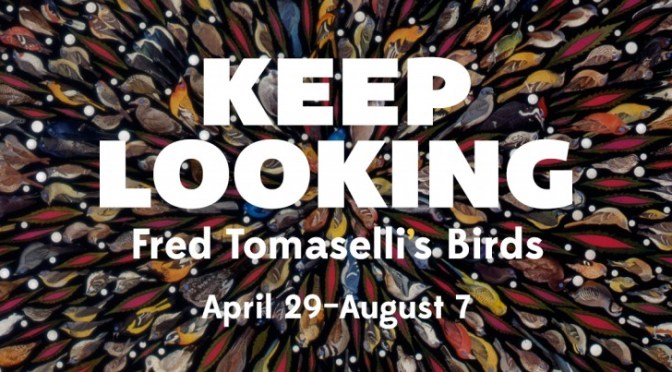
In Keep Looking: Fred Tomaselli’s Birds, now on exhibit at the Toledo Museum of Art,  the artworks first soothe and attract, then disquiet and disturb.  This  show is part of a series featuring   bird-related imagery which is held biennially in conjunction with a prominent yearly convention of birders in the Toledo area.  While this is as good a pretext as any for bringing this work to the rust belt, it doesn’t begin to describe the importance and interest of this artist.

Tomaselli Mob
Mob 2016

I have been a fan of Fred Tomaselli’s paintings for years, and looked forward to this golden opportunity to see them in person without buying a plane ticket (thanks TMA!) This show includes 5 paintings, a tapestry and a few assorted works on paper, all installed in Gallery 6 of the museum’s contemporary art wing.

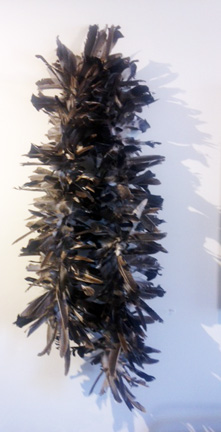
The first thing you respond to in looking at a Tomaselli painting is its sheer obsessive  and hallucinatory beauty. The paintings feature layers of meticulously collaged images covered in resin and then over-painted.  The black backgrounds evoke night skies and acid trips. Though it isn’t mentioned in the accompanying museum text, it’s clear that Tomaselli is no stranger to altered states.

artwork_images_117082_505034_fred-tomaselli
Bird Battle

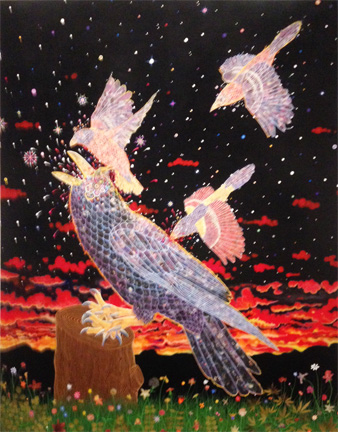
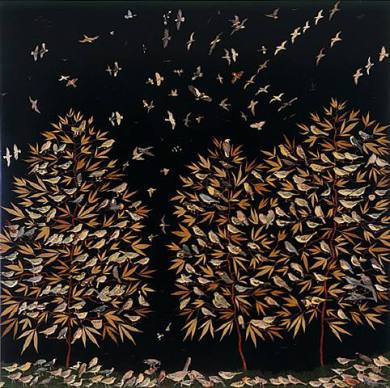
I loved all these paintings, but my favorite was Bird Battle (1997). The subdued palette and obsessive repetition of cutout birds with human eyes and (actual) hemp leaves put me in mind of some outsider visionary art.  From a distance the painting delivers a pleasurable punch of decorative pattern.  But as you draw near you see that this is a savage battle of all against all.  Birds attack each other in the air and in the trees, with many lying newly dead on the ground.  Tomaselli has distilled in one image all the beauty and all the cruelty of nature. In other pieces in this show, birds attack each other (Bird Mob), eat insects (Starling) and steal fruit (Migrant Fruit Thugs) but because the paintings are so intricately gorgeous  you can’t look away. You must keep looking.

Keep Looking: Fred Tomaselli’s Birds is on exhibit until August 7.  To see this must-see work and to get more information about hours and directions to the Toledo Museum of Art go here 


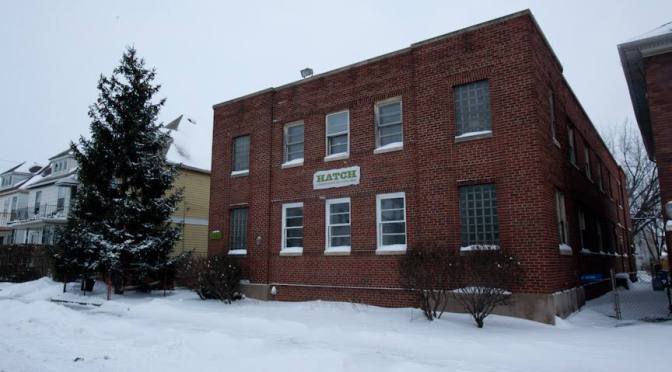
Hatch Art buys Hamtramck Disneyland

The non-profit artists’ collective and gallery Hatch Art  has purchased  Dmytro Szylak’s Hamtramck Disneyland, an extensive outdoor installation of handmade folk art along with the  two homes located on the property. Szylak, a Ukrainian immigrant and former GM autoworker,  created the work beginning in 1992. It was completed in 1999. He died in 2015 at 92, leaving uncertain prospects for the property and its art.

For a time inheritance disputes left the future uncertain, but recently the homes – and the art – were put on the market with the expressed preference of the seller (although not the requirement) that the work remain intact. To the relief of many, Hatch Art has stepped in to purchase and preserve Hamtramck Disneyland.

Hamtramck Mayor Karen Majewski calls Hamtramck Disneyland “a work of a premiere Hamtamck artist,” a “tourist destination worldwide,” a “neighborhood institution” and an expression of the immigrant and working-class experience in Hamtramck. “There is no alternative but preservation,” she adds.

Scott Collins, president of Hatch Arts’ board of directors, said his group purchased the property after obtaining a private loan. He said they plan to open the houses to tenants this summer, and start restoring and sprucing up the backyard artwork.
One goal is restoring the electric lights around the installation that haven’t worked for years. “We are going to make a lot of extra efforts to preserve the art,” Collins said. “It’s been a landmark in the city for a long time. It’s a great example of Hamtramck history, immigrant history and the independent arts scene.”

To get a tour of this unique site-based installation you can go here

Arts Writing in the Rust Belt

In the cities of the Rust Belt, arts writing is distinguished by how much of it there isn’t. The upper mid-west is thought of -when it’s thought of at all-by the art establishment on the coasts as a cultural backwater. But we all know that there are many, many artists living and making and showing their art here. Much of the work is good, some of it great.  But because regional arts writing is so scarce, artists often don’t get the attention their work deserves. Artists with ambitions to acquire a broad  audience are forced to decamp for New York or L.A. (or at least Chicago) to get a viewing.

The Rust Belt’s woeful shortage of thoughtful arts writing  is the result of a number of unfortunate historical facts and technological trends. The financial hardships of  mainline news media have forced them to re-organize as online platforms with unsteady revenue streams. Legacy newspapers like the Detroit News, the  Detroit Free Press, and the Ann Arbor News, never enthusiastic commentators on the visual arts of the region in  any case, have eliminated staff writers who covered the cultural scene. In some cases these writers have been replaced by unpaid or poorly paid online stringers. Often they haven’t been replaced at all. In this  critical vacuum, the arts ecosystem in the northern mid-west lacks the intellectual oxygen that allows it to breathe and grow. And most importantly for artists, without arts writers to provide context for the art consuming public, there is no consensus – or even discussion – on the relative importance, interest or value of various artists and approaches to art.

But there’s no reason this has to be the story of Rust Belt  art commentary going forward.  There are a few online and/or print arts magazines such as Hyperallergic, Flashart, Art in America and Artfixdaily that write occasionally about art news here in Southeast Michigan.

More importantly there are now a few fairly new blogs and websites that cover artists and the arts in Detroit and environs.  Herewith a list:

And if you just want a comprehensive listing of art exhibits and events go to: http://artdetroitnow.com/

I’d love to hear from readers of this post about any other arts blogs or online journals.  Just send me the link and I’ll post!


Changes Coming to TAA – 95 Blog

When I originally published TAA-95 a year and a half ago, I expected this blog to serve as a way for the artists participating in the Toledo Area Artists 95 exhibit at the Toledo Art Museum to keep in touch and to spread news on their art exhibits, projects, professional accomplishments and the like.  It turns out that I vastly over-estimated the appetite of my TAA artist friends for self promotion! Either because they are way too modest or just don’t have an appetite for verbal self-expression, very few posts have been forth-coming.  I find I am writing about regional artists and art issues pretty much on my own.  That’s not a bad thing, just different from what I intended at the outset.

On the other hand, I find that the more I express my opinion and share information about art events in Southeast Michigan and Northeast Ohio,   the more I enjoy it. Recently, with a bit of  (perhaps ill-considered) encouragement from talented arts writer and Kresge Fellow Sarah Rose Sharp, I’ve started to cover regional art news in more detail.  I’m not writing because I’m a great writer (though I hope to improve over time) but because I don’t think there is enough coverage of visual artists and the arts in our region.

To reflect the more personal nature of this blog going forward, I will be making some changes in its format.  Soon the domain name will change from taae95artists.wordpress.com  to rustbeltarts.com, and I’ll be tweaking  the home page appearance. Other than that, those of you following the blog won’t notice much difference (except I will be posting even more frequently).  I still hope to hear from the artists in last year’s Toledo Art Museum exhibit whenever they have something to report, but in future I will be the sole author on this blog.


Hatch Hamtramck is 10 Years Old

It doesn’t seem possible,  but time flies and Hatch Hamtramck has been around now for ten years.  In celebration, the non-profit studio and gallery has organized its tenth annual juried exhibit Hatchback 10. This  comprehensive  exhibit, juried by Detroit art personality James Dozier, features 55 Hatch artists and is on display through April 30.

A celebratory 10th Anniversary Party will be held 6-10 on Saturday, April 30 in the Gallery. The event is free and open to the public.

Hatch10-1
Dumped for a Stripper by Erin K. Schmidt

Hatch is the brainchild of Hatch president Christopher Schneider and Erik Tungate, Hamtramck’s former Director of Community & Economic Development. They saw a need for an artist community that would promote Hamtramck in a positive way, where artists could pool their resources to challenge each other and reach out to the greater community.

United by the shared mission of Education, Expression and Exhibition, the group rapidly gained followers and supporters. Regular meetings were held in community centers, local businesses and artists’ studios. In 2007, Hatch achieved 501[c]3 nonprofit status and developed a full calendar of events. Within its first year of existence, Hatch founded the Detroit chapter of Dr. Sketchy’s Anti Art School, represented Hamtramck artists at 2 art fairs, and hosted concerts, critiques, educational workshops and more.

Hatch purchased the old police station at 3456 Evaline from the City of Hamtramck in 2008. For the next four years, renovations were made, concurrent with fundraising and maintaining a full events schedule. A new roof and central heating system were made possible through grants and crowd sourcing campaigns. Volunteers put in countless hours to help convert the former police station into a space for making and exhibiting art.

hatch10-3
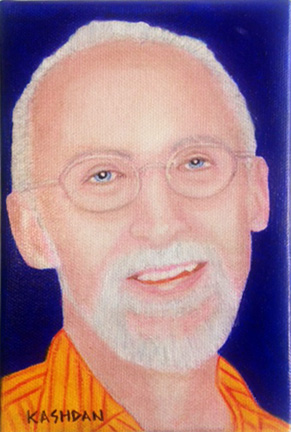
Portrait of Jack Summers by Deborah Marlow Kashdan

Hatch Gallery officially opened in April 2012. Upstairs, studios became available for rent in July and were at full occupancy by the year’s end. Classroom space was finished in March 2013.


“Them” at Butter Projects in Royal Oak

Luxury, identity, class, perversity, carnality, playfulness… Royal Oaks’ Butter Projects has stirred it all together to create a thoughtful visual feast that describes what lies on the surface and what lies beneath.  “THEM” is loosely framed around portraiture, commonly defined as a representation or likeness of a specific individual, but each artist has gone far beyond the mere creation of a likeness to portray the unseen  reality below the surface.

Thirty-three beautifully rendered black and white gestural portrait studies by William Irving Singer anchor the show against an meticulously painted blue brocade background.  The portraits, which are made with black acrylic on coarse un-primed canvas, comment ironically on the society portrait as a signifier of wealth and importance. The lone likeness by Singer which features color, entitled Some Sort of Lunch Line, seems to portray a member of the have-not class who nonetheless sports a kind of jaunty elegance. somesortoflunchline

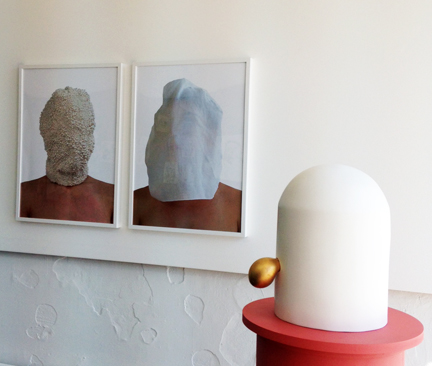
Works by Lauren Kalman consist of fetishistic photographs of  hooded women. The effect of these photographs is ominous and seems to indicate that the woman portrayed is engaged in some kind of luxurious pearl-encrusted sex play. She is not powerless, but she is immobilized.

The photographs are accompanied by formal hood-like clay or pigskin sculptures, some with corks or objects stuffed in the apertures where one would expect to find eyes or mouths. They are both humorous  and disturbing.

But if the crime is beautiful

As if to add some lightness to this otherwise serious exploration of the self, Butter Projects has included three-dimensional work from artist Kat Burdine. These canines are engaged in doing what dogs do and doing it with abandon: pooping, groveling and licking…no inner angst here. Entitled “Strays” these  chunky life-sized wooden creatures project a kind of joy in spite of  their displacement.

butter dog

During the run of the exhibition, Butter Projects will hold open hours Saturdays and Sundays from 1-3pm. Additional hours can be made by appointment. Them will be on exhibit until May 7, 2016

Butter Projects is an artist run studio and exhibition space. For more information contact Alison Wong butter.projects@gmail.com

Butter Projects, 814 W. 11 Mile, Royal Oak, MI 48067


Breakfast With an Artist!

Sharp_Sarah-Rose-300x300I recently had the pleasure of meeting arts writer Sarah Rose Sharp when she served as juror for a show I was in at the Walter E. Terhune Gallery in Perrysburg, Ohio.

Sharp is a recent recipient of a Kresge Grant for her writing on art criticism. She writes for multiple print publications and online platforms such as Art in America. Hyperallergic and Knight Arts to name only a few. In addition to writing long form essays on Detroit artists for Essay’d ( http://essayd.org/), she keeps a  lively blog called “Breakfast with an Artist”.  In this more informal format, Sharp enters into  open-ended discussions with artists on arts issues and the Rustbelt art scene in general. Here is a sample of her style, lifted from her most recent breakfast-with-the-artist post:

“You are not a Detroiter until you have learned the skill of delayed gratification, pride in work for its own sake, patience patience patience (I hate learning this. HATE IT). I am a different person than I was when I first arrived, and I am eternally grateful to Detroit for teaching me how to be that person, not to mention the first communities here that welcomed me, even as a vain and unproven entity, lost in my own searching.”

Pretty eloquent and spot on, right? I also had breakfast with her last week and was energized by her thoughts about the art community in Detroit and environs.  If you want to check it  out(and you really should) go to: http://sarahrosesharp.com/blog/